Poseidon
God of the sea, who hounds Odysseus after the blinding of his son.
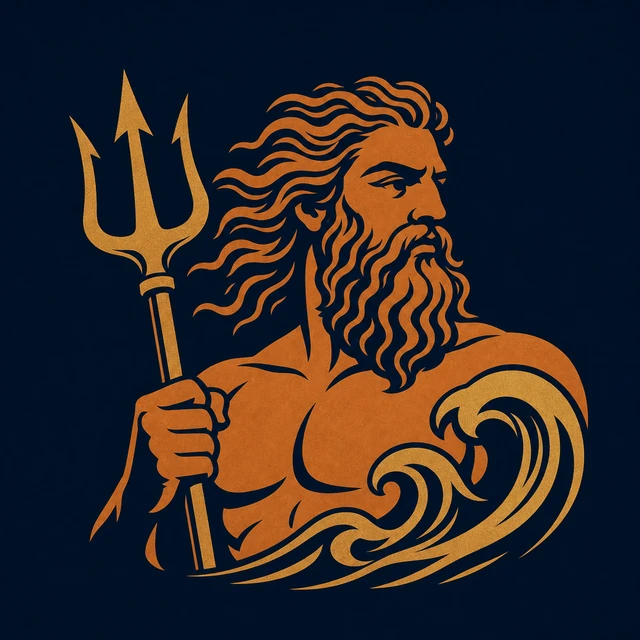
Overview
Poseidon is a son of Cronus and Rhea as well as god of the sea and the shaking earth. The Theogony first numbers him among the six siblings swallowed by their father and later released in the succession reversal, placing the powerful sea ruler of the Odyssey within the transfer of Olympian power. In the homecoming story he becomes the most sustained opposition after Odysseus blinds his son Polyphemus. Poseidon cannot wholly overturn the return allowed by Zeus, but storms, drift and maritime danger change its timing and cost. He also punishes the Phaeacian ship that carries Odysseus home, showing that aid to a voyager can carry consequences under the sea god's rule. The Bibliotheca gives him the sea by lot after the war, while the hymn lists him as a suitor whom Hestia rejects. Neither context is a basis for a universal Twelve Olympians roster. The later Bibliotheca gives him the sea by lot after the war, while the hymn lists him as a suitor whom Hestia rejects. Neither context is evidence for a universal Twelve Olympians roster. In Pseudo-Apollodorus’ Titanomachy account, as one of the released siblings he receives the Cyclopes’ trident; the ancient passage gives him no separate combat feat.
Key facts
Fatherhood and the prayer for revenge
Once Polyphemus learns the attacker's name, he asks his father to make Odysseus return late, alone and to trouble at home if return is fated.
The storm after Ogygia
Seeing Odysseus leave on a raft, Poseidon gathers winds and waves, wrecks the craft and forces him to swim toward Phaeacia.
The Cyclopes' trident
Pseudo-Apollodoran accountPseudo-Apollodorus says the Cyclopes give Poseidon the trident.
Sea received by lot
Pseudo-Apollodoran accountPseudo-Apollodorus says Poseidon receives the sea in the brothers' drawing of lots.
Further spoiler details are available in the interactive atlas.
Relationships
- Polyphemusfather of
Polyphemus calls on his father Poseidon for vengeance.
- Odysseuspersecutes
Poseidon prolongs the wanderings after Polyphemus is harmed.
- Alcinouspunishes aid
Poseidon punishes the Phaeacian ship for carrying Odysseus home.
- Poseidon's Stormraises
Poseidon spots Odysseus at sea and raises the storm.
- Blinding of Polyphemusprovokes
Polyphemus' prayer brings Poseidon's wrath upon the voyage.
- Poseidon's Stormcauses
The sea god gathers winds and waves to break the raft.
- Rheamother of
Rhea is the mother of Poseidon.
- Cronusfather of
Cronus is the father of Poseidon.
- The Swallowing of the Childrenis swallowed in
Poseidon is swallowed by Cronus after his birth.
- Cyclopesgive the trident
In Pseudo-Apollodorus, the Cyclopes give Poseidon the trident.
- Olympian Orderreceives the sea by lot
The later Bibliotheca says Poseidon receives the sea by lot.
- Hestiaseeks marriage
The hymn says Poseidon seeks marriage with Hestia.
- Hestiasiblings
Poseidon and Hestia are both children of Cronus and Rhea.
Story appearances
- The Odyssey HomecomingSea god who obstructs the return
Answering his son's prayer, Poseidon delays Odysseus through wandering and storm.
- Birth of the GodsSwallowed divine sibling
The sea god of the proem is placed in the family as a son of Rhea and Cronus, swallowed and then released by the succession reversal.
- The TitanomachyReleased sibling and later-version weapon recipient
Released sibling and later-version weapon recipient within the struggle between the older Titans and Zeus' side.
- Olympian OrderRecipient of the sea within Olympian power
Recipient of the sea within Olympian power within the family, honours or council order that follows Zeus' victory.
Ancient sources
MythWeave distinguishes ancient-source evidence from later adaptations and modern interpretation.
- Homer, Odyssey, Books 1–24
- Hesiod, Theogony, Complete poem
- Hesiod, Theogony, Lines 1–115: the Muses, the poet's commission and the questions of divine origins
- Hesiod, Theogony, Lines 453–467: Rhea bears six children and Cronus swallows them because of the succession prophecy
- Hesiod, Theogony, Lines 492–506: Cronus releases the children, Zeus sets up the stone, frees the Cyclopes and receives thunder
- Hesiod, Theogony, Lines 468–491: Rhea seeks help, Zeus is hidden in Crete and a swaddled stone is substituted
- Pseudo-Apollodorus, Bibliotheca, 1.2.1: Metis' drug, ten-year war, Gaia's prophecy, Campe, three weapons, Titan imprisonment and division by lot
- Hesiod, Theogony, Lines 617–653: prolonged war, the Olympus and Othrys camps, Gaia's counsel to free the Hundred-Handers, and Zeus's invitation to fight
- Hesiod, Theogony, Lines 687–735: Zeus' thunder, cosmic upheaval, three hundred stones, and the Titans defeated and bound
- Hesiod, Theogony, Lines 736–806: Tartarus' depth, bronze enclosure, gates and threshold
- Hesiod, Theogony, Lines 807–819: the Titans dwelling beyond the gates and the later stations of Cottus, Gyes and Briareus
- Homeric Hymn tradition, Homeric Hymn to Aphrodite, Lines 1–32: three exempt goddesses and Hestia's oath and honour
- Homer, Iliad, Book 1.493–611: Thetis's petition, Zeus and Hera's quarrel and Hephaestus' mediation
- Homer, Odyssey, Book 1.26–95: the divine council discusses Odysseus's return
- Homer, Odyssey, Book 5.1–42: council decision and Zeus's commission to Hermes
- Homer, Odyssey, Book 9.39–566: post-war voyage and Polyphemus
- Homer, Odyssey, Book 5: Ogygia, release and storm
- Homer, Odyssey, Book 13: Phaeacian passage and return to Ithaca