Cyclopes
Three one-eyed brothers whose release by Zeus is answered with the gift of thunder.
Overview
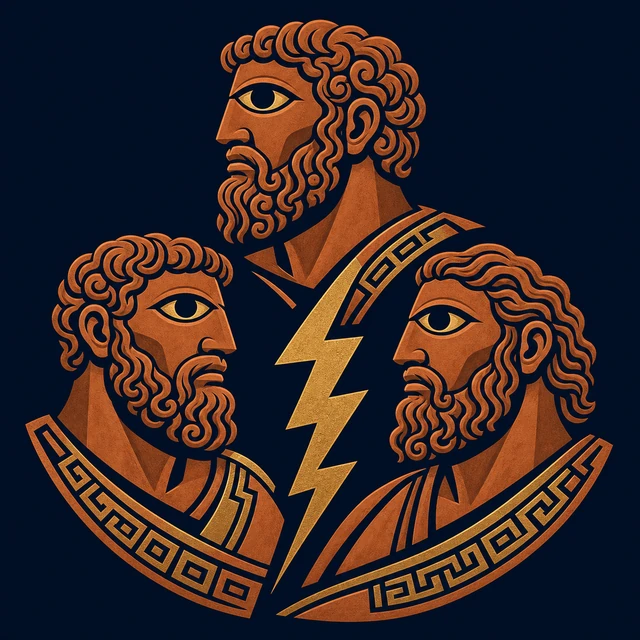
The Cyclopes are represented collectively here as the three brothers Brontes, Steropes and Arges. Hesiod makes them children of Gaia and Uranus, shaped like gods but with one eye in the forehead; their names evoke thunder, lightning and brightness. Uranus hides them, and Zeus later frees them from bondage. The poem calls the release a kindness but does not say Zeus acts to obtain weapons. Remembering the favour, they give thunder, lightning and the thunderbolt, establishing power for the next book’s Titanomachy without narrating that war here. The Titanomachy carries the thunder gift into battle; Pseudo-Apollodorus separately adds Poseidon's trident and Hades's helmet, so the three weapons need to be read by source.
Key facts
Three one-eyed brothers
Hesiod names Brontes, Steropes and Arges and describes the single eye set in each forehead.
Later three-weapon account
Pseudo-Apollodoran accountPseudo-Apollodorus says the Cyclopes arm Zeus, Poseidon and Hades separately.
Further spoiler details are available in the interactive atlas.
Relationships
- Gaiamother of
Gaia is the mother of the Cyclopes.
- Uranusfather of
Uranus is the father of the Cyclopes.
- Zeusfrees from bonds
Zeus frees the Cyclopes from their bonds, an act the poem calls a kindness.
- Zeusgive thunder and thunderbolt
In gratitude for release, the Cyclopes give Zeus thunder, lightning and the thunderbolt.
- Poseidongive the trident
In Pseudo-Apollodorus, the Cyclopes give Poseidon the trident.
- Hadesgive the helmet
In Pseudo-Apollodorus, the Cyclopes give Hades the helmet.
Story appearances
- Birth of the GodsThree brothers moving from bondage to the gift of thunder
Hidden first by Uranus, they are freed by Zeus and answer with thunder, lightning and the thunderbolt.
- The TitanomachyFreed allies who provide weapons
Freed allies who provide weapons within the struggle between the older Titans and Zeus' side.
Ancient sources
MythWeave distinguishes ancient-source evidence from later adaptations and modern interpretation.
- Hesiod, Theogony, Lines 126–153: Gaia brings forth Sky, Mountains and Sea, then the children of Gaia and Uranus
- Hesiod, Theogony, Lines 154–187: Uranus hides his children, Gaia plans resistance, Cronus attacks and blood-born consequences follow
- Hesiod, Theogony, Lines 492–506: Cronus releases the children, Zeus sets up the stone, frees the Cyclopes and receives thunder
- Hesiod, Theogony, Lines 453–467: Rhea bears six children and Cronus swallows them because of the succession prophecy
- Hesiod, Theogony, Lines 468–491: Rhea seeks help, Zeus is hidden in Crete and a swaddled stone is substituted
- Pseudo-Apollodorus, Bibliotheca, 1.2.1: Metis' drug, ten-year war, Gaia's prophecy, Campe, three weapons, Titan imprisonment and division by lot
- Hesiod, Theogony, Lines 617–653: prolonged war, the Olympus and Othrys camps, Gaia's counsel to free the Hundred-Handers, and Zeus's invitation to fight