Alcinous
King of the Phaeacians, who hears Odysseus' tale and sends him home.
Overview
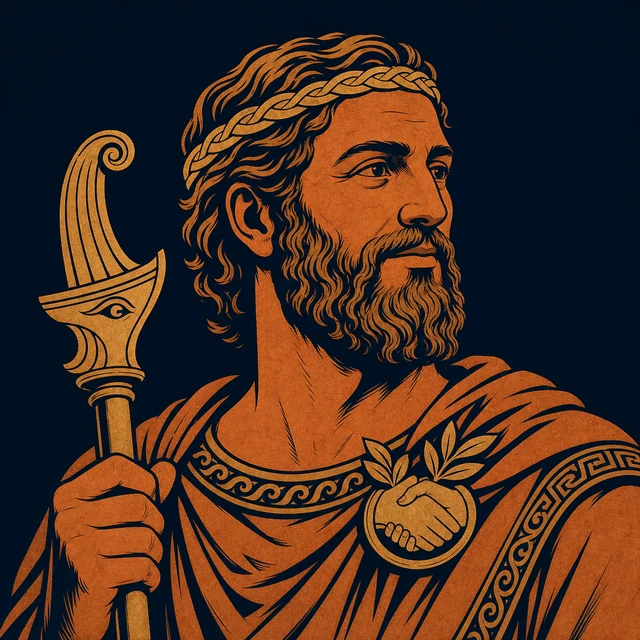
Alcinous rules the Phaeacians across Odyssey Books 6–13. He receives Odysseus as an unidentified stranger, summons the nobles, arranges feast and games, and promises passage to whatever homeland the guest names. When songs of Troy repeatedly make the stranger weep, Alcinous asks for his name and experience, creating the courtly setting in which Odysseus narrates his wanderings. He finally mobilises crew, ship and gifts to complete the return. The passage is therefore more than private kindness: it is a king's organisation of an entire community to fulfil hospitality.
Key facts
Asking identity after the tears
Odyssey Book 8Alcinous notices the stranger's grief during songs of Troy, halts the entertainment and asks for his name, homeland and voyage.
Organising the final passage
He orders Phaeacian sailors to prepare ship and gifts so the sleeping Odysseus and his property reach Ithaca safely.
Relationships
- Nausicaafather of
Alcinous is the father of Nausicaa.
- Aretemarried to
Alcinous and Arete rule the Phaeacians together.
- Odysseussends home
Alcinous provides the Phaeacian ship that carries Odysseus to Ithaca.
- Poseidonpunishes aid
Poseidon punishes the Phaeacian ship for carrying Odysseus home.
- Scheriarules
Alcinous rules the Phaeacians of Scheria.
- Nausicaaleads to court
Nausicaa's guidance enables Odysseus to appeal at court.
- Return to Ithacaenables return
The Phaeacian ship finally carries Odysseus to his homeland.
Story appearances
- The Odyssey HomecomingSponsor of the final passage
Alcinous hears the wanderer's tale and arranges the Phaeacian voyage home.
Ancient sources
MythWeave distinguishes ancient-source evidence from later adaptations and modern interpretation.