Hestia
The eldest daughter of Rhea and Cronus and the first child swallowed by her father.
Overview
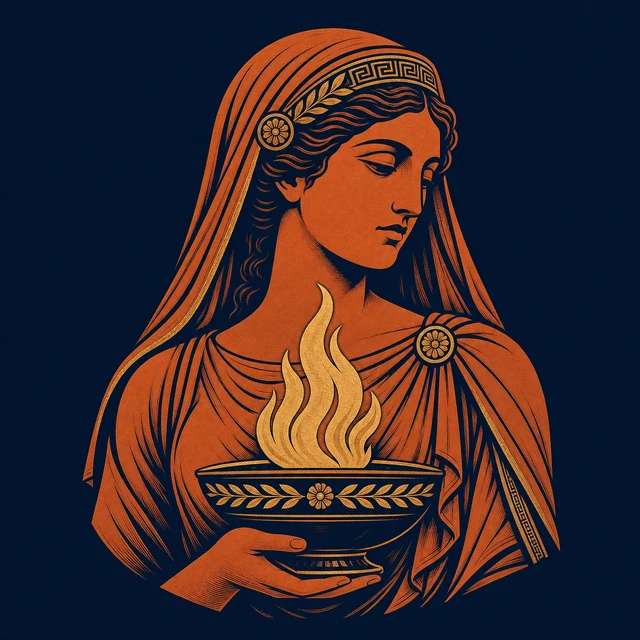
Hestia is the eldest daughter of Rhea and Cronus and the first child Cronus swallows. The birth, swallowing and release of all six siblings make the succession crisis an act against individual members of one household. A later hymn explains another part of her office: she refuses marriage to Poseidon and Apollo, swears before Zeus to remain a maiden, and receives the central hearth and first portion of offerings. Together, the traditions place her at the beginning of the sibling order and the centre of ritual hospitality.
Key facts
First to be swallowed
Hestia stands first in the list of Rhea’s children, and Cronus swallows her at birth.
Further spoiler details are available in the interactive atlas.
Relationships
- Rheamother of
Rhea is the mother of Hestia.
- Cronusfather of
Cronus is the father of Hestia.
- The Swallowing of the Childrenis swallowed in
Hestia is the first child swallowed by Cronus.
- Poseidonseeks marriage
The hymn says Poseidon seeks marriage with Hestia.
- Apolloseeks marriage
The hymn says Apollo seeks marriage with Hestia.
- Zeusgrants central honour
After Hestia's oath, Zeus gives her a central place in houses and temples.
- Poseidonsiblings
Poseidon and Hestia are both children of Cronus and Rhea.
Story appearances
- Birth of the GodsEldest daughter swallowed first
The eldest daughter of Rhea and Cronus, swallowed first and eventually released with her siblings.
- The TitanomachyOne of the released siblings
One of the released siblings within the struggle between the older Titans and Zeus' side.
- Olympian OrderHearth goddess whose refusal of marriage receives central honour
Hearth goddess whose refusal of marriage receives central honour within the family, honours or council order that follows Zeus' victory.
Ancient sources
MythWeave distinguishes ancient-source evidence from later adaptations and modern interpretation.
- Hesiod, Theogony, Lines 453–467: Rhea bears six children and Cronus swallows them because of the succession prophecy
- Hesiod, Theogony, Lines 492–506: Cronus releases the children, Zeus sets up the stone, frees the Cyclopes and receives thunder
- Hesiod, Theogony, Lines 468–491: Rhea seeks help, Zeus is hidden in Crete and a swaddled stone is substituted
- Pseudo-Apollodorus, Bibliotheca, 1.2.1: Metis' drug, ten-year war, Gaia's prophecy, Campe, three weapons, Titan imprisonment and division by lot
- Hesiod, Theogony, Lines 617–653: prolonged war, the Olympus and Othrys camps, Gaia's counsel to free the Hundred-Handers, and Zeus's invitation to fight
- Homeric Hymn tradition, Homeric Hymn to Aphrodite, Lines 1–32: three exempt goddesses and Hestia's oath and honour