Persephone
Queen of the Underworld, moving between the worlds of living and dead.
Overview
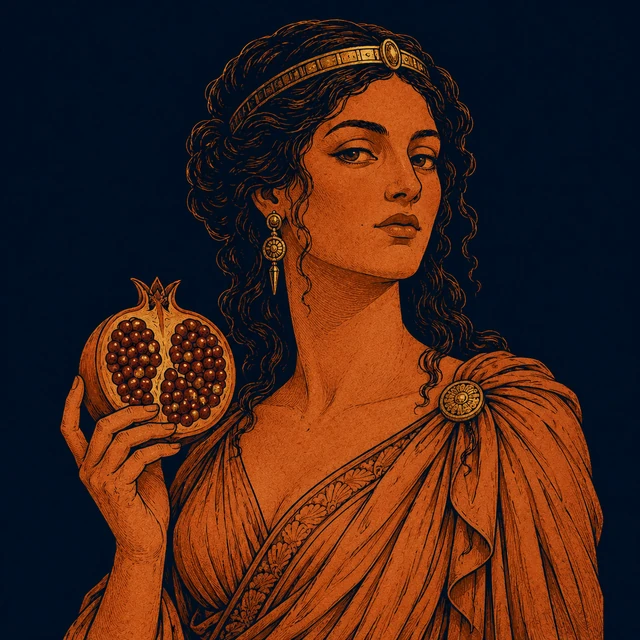
Persephone is both the maiden violently separated from her mother and a queen who holds authority below. At the opening of the Homeric Hymn to Demeter she is gathering flowers when Hades carries her underground in his chariot, under an arrangement already approved by Zeus. Only a few deities, including Hecate and Helios, hear her cries. When the gods respond to the famine caused by Demeter and demand her return, Hades gives her pomegranate seed, preventing that return from becoming permanent departure. The settlement divides her year between the underworld and her mother. The hymn preserves coercive separation while also presenting Persephone as a ruler with powers of judgement among the dead.
Key facts
Taken below while gathering flowers
After the earth produces a wondrous narcissus, Hades breaks through in his chariot and carries away the crying Persephone; the hymn explicitly says Zeus consented.
The pomegranate limits the return
Return account in the Homeric Hymn to DemeterBefore Hermes can escort her away, Hades has her swallow pomegranate seed; the final agreement therefore divides the year between time below and time above.
Relationships
- Demetermother of
Persephone is the daughter of Demeter.
- Hadesunderworld consorts
Hades and Persephone rule the Underworld together.
- Underworldrules
Persephone is the dread queen of the Underworld.
- Zeusfather of
Hesiod names Zeus as Persephone's father in this genealogy.
- Hadestakes away
Hesiod says Hades takes Demeter's daughter away.
- Hecatehears her cry
Hecate hears Persephone’s cry from her cave as the maiden is taken.
- Hermesescorts her from below
Hermes obeys Zeus and escorts Persephone out of the hidden places.
- Hadesmakes her taste pomegranate seed
Before the return, Hades makes Persephone swallow pomegranate seed.
- Underworldreturns for part of each year
The hymn’s settlement places Persephone below for part of each year and with her mother for the rest.
- Tiresiasallows understanding after death
Circe says Persephone allows Tiresias to retain understanding after death.
- Eurydicepermits a conditional return
Persephone lets Eurydice follow Orpheus back under a condition against looking back before departure.
- Ascalaphusreveals the pomegranate
In the Pseudo-Apollodorus route, Ascalaphus reveals that Persephone has eaten pomegranate seeds.
Story appearances
- Olympian OrderFigure or event appearing in Olympian Order
Figure or event appearing in Olympian Order within the family, honours or council order that follows Zeus' victory.
- Gates of the UnderworldQueen forcibly taken, seasonally returned and later granting conditions
Queen forcibly taken, seasonally returned and later granting conditions, part of the Underworld story's crossings, losses, judgments or guarded spaces.
Ancient sources
MythWeave distinguishes ancient-source evidence from later adaptations and modern interpretation.
- Homer, Odyssey, Books 1–24
- Homeric tradition, Homeric Hymns, Hymns to the gods
- Hesiod, Theogony, Lines 907–918: households of Eurynome, Demeter and Mnemosyne
- Hesiod, Theogony, Lines 1–115: the Muses, the poet's commission and the questions of divine origins
- Homeric tradition, Homeric Hymn 2 to Demeter, Lines 1–39: Persephone is taken and Hecate hears her cry
- Homeric tradition, Homeric Hymn 2 to Demeter, Lines 305–356: famine and Zeus sends Hermes below
- Homeric tradition, Homeric Hymn 2 to Demeter, Lines 357–433: pomegranate, escorted return and divided year
- Homer, Odyssey, Book 10.487–540: Circe’s command and the route toward Acheron
- Homer, Odyssey, Book 11.90–151: Tiresias prophesies the return and later obligation
- Pseudo-Apollodorus, Bibliotheca, 1.3.2: Orpheus, Eurydice and the condition against looking back
- Pseudo-Apollodorus, Bibliotheca, 2.5.12: Taenarum, Hades’ condition, unarmed mastery, display and return
- Homeric tradition, Homeric Hymn 2 to Demeter, Lines 1–304: Persephone's removal, Demeter's search and Eleusis
- Homeric tradition, Homeric Hymn 2 to Demeter, Lines 305–495: famine, Persephone's return, the pomegranate and seasonal settlement