Hermes
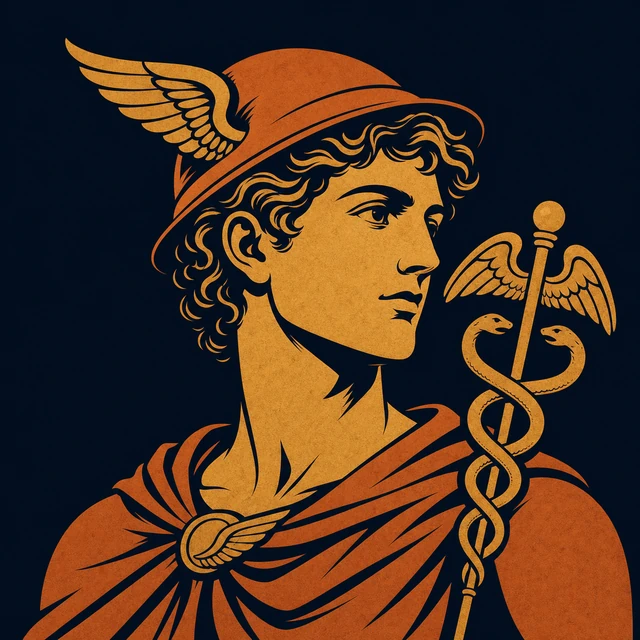
Messenger of the gods, aiding Odysseus in the Circe and Calypso episodes.
Overview
Hermes works across herding, roads, protective tools and the delivery of divine commands. The Theogony pairs him with Hecate as a power who can increase or diminish cattle, sheep and goats; the Odyssey places him at two decisive boundaries. In Book 10 he meets Odysseus in youthful form in the forest, gives him moly against Circe's drugs and explains how to demand an oath. In Book 5 he crosses the sea to Ogygia and carries Zeus' order that Calypso release the voyager. These interventions do not complete another person's task: Hermes supplies resources, procedure or legitimate command, while the recipient must still act.
Key facts
The difficult herb moly
Odyssey Book 10Hermes pulls up moly, black at the root and white in flower; difficult for mortals to obtain, it protects against Circe's drug.
Carrying the order to Calypso
With golden sandals he crosses the sea to Ogygia and communicates Zeus' fixed decision that the homecoming must proceed.
Increasing herds together with Hecate
Hesiodic TheogonyThe Theogony joins Hecate with Hermes in the fortunes of livestock: she may increase cattle, goats and sheep from a few or diminish a large stock.
Escorting Persephone into the light
Hermes enters Hades’ house on Zeus’ command, negotiates and escorts Persephone back to her mother.
Guiding the suitors’ shades with the golden wand
Odyssey 24 has Hermes summon the shades and lead them to the Asphodel Meadow.
Giving voice and naming Pandora
Hesiod, Works and Days traditionWorks and Days has Hermes give the woman a voice and name her Pandora because the Olympians each bestowed a gift.
Relationships
- Zeusfather of
Hermes is the son of Zeus and Maia.
- Odysseusaids
Hermes supplies the moly herb and carries the order for Odysseus' release.
- Hecateincrease herds together
Hesiod says Hecate, together with Hermes, can increase herds of cattle, sheep and goats.
- Zeuscommissions the decree
Zeus commissions Hermes to announce the fixed decision of Odysseus's return to Calypso.
- Zeussends below for Persephone
As famine continues, Zeus sends Hermes to Hades to bring Persephone back.
- Persephoneescorts her from below
Hermes obeys Zeus and escorts Persephone out of the hidden places.
- Underworldguides the newly dead
Hermes uses his golden wand to summon and lead the suitors’ shades to the realm of the dead.
- Pandoragives voice and names
In Works and Days, Hermes gives her voice and the name Pandora.
- Maiamother of
Homeric Hymn 4 presents Maia as the mother of Hermes.
- Panfather of
Homeric Hymn 19 connects Pan's birth with Hermes.
Story appearances
- The Odyssey HomecomingHelper across divine and mortal boundaries
Hermes supplies the herb against Circe and carries the command to release Odysseus.
- Birth of the GodsIncreases herds together with Hecate
Hesiod joins Hecate and Hermes in increasing herds of cattle, sheep and goats.
- Olympian OrderMessenger commissioned to carry the council's decision
Messenger commissioned to carry the council's decision within the family, honours or council order that follows Zeus' victory.
- Gates of the UnderworldBoundary-crossing messenger escorting Persephone and newly dead shades
Boundary-crossing messenger escorting Persephone and newly dead shades, part of the Underworld story's crossings, losses, judgments or guarded spaces.
Ancient sources
MythWeave distinguishes ancient-source evidence from later adaptations and modern interpretation.
- Homer, Odyssey, Books 1–24
- Hesiod, Theogony, Lines 404–452: Hecate's genealogy and Zeus' preservation and enlargement of her honours
- Homer, Iliad, Book 1.493–611: Thetis's petition, Zeus and Hera's quarrel and Hephaestus' mediation
- Homer, Odyssey, Book 1.26–95: the divine council discusses Odysseus's return
- Homer, Odyssey, Book 5.1–42: council decision and Zeus's commission to Hermes
- Homeric tradition, Homeric Hymn 2 to Demeter, Lines 1–39: Persephone is taken and Hecate hears her cry
- Homeric tradition, Homeric Hymn 2 to Demeter, Lines 305–356: famine and Zeus sends Hermes below
- Homeric tradition, Homeric Hymn 2 to Demeter, Lines 357–433: pomegranate, escorted return and divided year
- Homer, Odyssey, Book 24.1–14: Hermes leads the suitors’ shades to the asphodel meadow
- Pseudo-Apollodorus, Bibliotheca, 2.5.12: Taenarum, Hades’ condition, unarmed mastery, display and return
- Hesiod, Works and Days, Lines 59–82: the gods fashion and adorn the woman; Hermes gives voice and the name Pandora
- Homer, Odyssey, Book 10.133–574: Circe and directions to the dead
- Homer, Odyssey, Book 5: Ogygia, release and storm