Hades
Ruler of the realm of the dead.
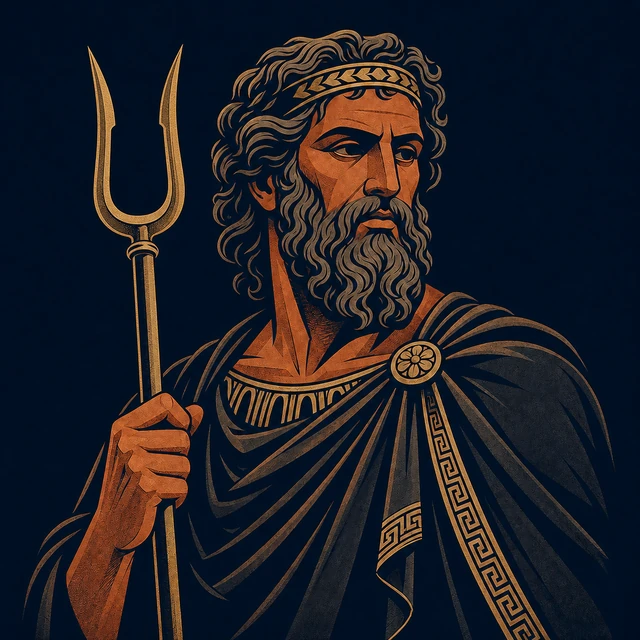
Overview
Hades is a son of Rhea and Cronus and ruler of the underworld, not death itself or a simple embodiment of evil. The Theogony numbers him among the six siblings swallowed by their father and later released in Zeus’ succession reversal. The Homeric Hymn to Demeter then calls him the Host of Many and brother of Zeus. With Zeus’ consent he carries Persephone underground, provoking Demeter’s suspension of agriculture. When Zeus orders her release, Hades outwardly complies but first gives her pomegranate seed so that she must return periodically, while promising her extensive rights below. In the Bibliotheca’s Titanomachy account, as one of the released siblings he receives the Cyclopes’ helmet; his allotment of the underworld belongs to the later division by lot among the three brothers.
Key facts
Taking Persephone with Zeus' consent
Homeric Hymn to DemeterThe hymn does not present the event as Hades acting alone: Zeus authorizes the arrangement, while the protesting maiden is carried below by chariot.
Granting rights to an underworld queen
As Persephone prepares to leave, Hades says she will rule those below and possess great honours, while the pomegranate ensures that she must still return.
The Cyclopes' helmet
Pseudo-Apollodoran accountPseudo-Apollodorus says the Cyclopes give Hades the helmet.
Underworld received by lot
Pseudo-Apollodoran accountPseudo-Apollodorus says Hades receives the underworld in the brothers' drawing of lots.
Further spoiler details are available in the interactive atlas.
Relationships
- Persephoneunderworld consorts
Hades and Persephone rule the Underworld together.
- Underworldrules
Hades rules the world of the dead.
- Rheamother of
Rhea is the mother of Hades.
- Cronusfather of
Cronus is the father of Hades.
- The Swallowing of the Childrenis swallowed in
Hades is swallowed by Cronus after his birth.
- Cyclopesgive the helmet
In Pseudo-Apollodorus, the Cyclopes give Hades the helmet.
- Olympian Orderreceives Hades by lot
The later Bibliotheca says Hades receives the underworld by lot.
- Zeusgrants the taking of Persephone
Hesiod tersely says Hades takes Persephone with Zeus's grant.
- Persephonetakes away
Hesiod says Hades takes Demeter's daughter away.
- Persephonemakes her taste pomegranate seed
Before the return, Hades makes Persephone swallow pomegranate seed.
- Heraclespermits the hound to be taken conditionally
Hades permits Heracles to take Cerberus on condition that he use none of his carried weapons.
Story appearances
- Birth of the GodsSwallowed divine sibling
Son of Rhea and Cronus, swallowed by his father at birth and later released with the other siblings.
- The TitanomachyReleased sibling and later-version weapon recipient
Released sibling and later-version weapon recipient within the struggle between the older Titans and Zeus' side.
- Olympian OrderRecipient of the underworld who takes Persephone
Recipient of the underworld who takes Persephone within the family, honours or council order that follows Zeus' victory.
- Gates of the UnderworldRuler below, taker of Persephone and granter of the Cerberus condition
Ruler below, taker of Persephone and granter of the Cerberus condition, part of the Underworld story's crossings, losses, judgments or guarded spaces.
- The Labours of HeraclesHades in the Labours
Hades enters this story through Heracles' labours; when other stories return to the figure, they follow that later setting.
Ancient sources
MythWeave distinguishes ancient-source evidence from later adaptations and modern interpretation.
- Homer, Odyssey, Books 1–24
- Hesiod, Theogony, Complete poem
- Hesiod, Theogony, Lines 453–467: Rhea bears six children and Cronus swallows them because of the succession prophecy
- Hesiod, Theogony, Lines 492–506: Cronus releases the children, Zeus sets up the stone, frees the Cyclopes and receives thunder
- Hesiod, Theogony, Lines 468–491: Rhea seeks help, Zeus is hidden in Crete and a swaddled stone is substituted
- Pseudo-Apollodorus, Bibliotheca, 1.2.1: Metis' drug, ten-year war, Gaia's prophecy, Campe, three weapons, Titan imprisonment and division by lot
- Hesiod, Theogony, Lines 617–653: prolonged war, the Olympus and Othrys camps, Gaia's counsel to free the Hundred-Handers, and Zeus's invitation to fight
- Hesiod, Theogony, Lines 687–735: Zeus' thunder, cosmic upheaval, three hundred stones, and the Titans defeated and bound
- Hesiod, Theogony, Lines 736–806: Tartarus' depth, bronze enclosure, gates and threshold
- Hesiod, Theogony, Lines 807–819: the Titans dwelling beyond the gates and the later stations of Cottus, Gyes and Briareus
- Hesiod, Theogony, Lines 907–918: households of Eurynome, Demeter and Mnemosyne
- Hesiod, Theogony, Lines 1–115: the Muses, the poet's commission and the questions of divine origins
- Homeric tradition, Homeric Hymn 2 to Demeter, Lines 1–39: Persephone is taken and Hecate hears her cry
- Homeric tradition, Homeric Hymn 2 to Demeter, Lines 305–356: famine and Zeus sends Hermes below
- Homeric tradition, Homeric Hymn 2 to Demeter, Lines 357–433: pomegranate, escorted return and divided year
- Pseudo-Apollodorus, Bibliotheca, 2.5.12: Taenarum, Hades’ condition, unarmed mastery, display and return
- Euripides, Heracles, Lines 1–25: the family awaits Heracles as he completes the Cerberus task
- Euripides, Heracles, Lines 815–1015: Iris and Lyssa bring madness after the hero returns
- Homeric tradition, Homeric Hymn 2 to Demeter, Lines 1–304: Persephone's removal, Demeter's search and Eleusis
- Homeric tradition, Homeric Hymn 2 to Demeter, Lines 305–495: famine, Persephone's return, the pomegranate and seasonal settlement