Hecate
A goddess whose honours across sky, earth and sea are preserved by Zeus.
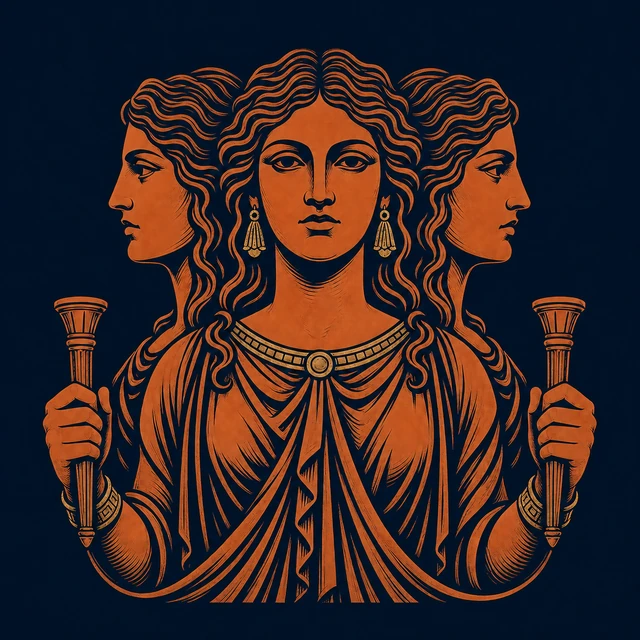
Overview
Hesiod says Zeus does not take away her earlier portion and instead grants splendid gifts. Her powers extend across earth, sea and sky and can assist petitioners in contests, war, herding and fishing. The source does not say why Zeus treats her this way, so the explanation records continuity and result without inventing favouritism or a bargain.
Key facts
Daughter of Asteria and Perses
Hesiod introduces Hecate as daughter of Asteria and Perses before turning to her portions and functions.
Honours retained across regimes
Zeus does not remove Hecate’s earlier shares in earth, sea and sky, granting splendid gifts and wide powers of assistance.
Medea’s priesthood and night rite
Medea is Hecate’s priestess and directs Jason to invoke the goddess in a night rite before the trial.
Relationships
- Zeuspreserves and enlarges honours
Zeus does not take away Hecate’s earlier portion and grants splendid gifts.
- Hermesincrease herds together
Hesiod says Hecate, together with Hermes, can increase herds of cattle, sheep and goats.
- Persephonehears her cry
Hecate hears Persephone’s cry from her cave as the maiden is taken.
- Medeaserves as priestess
Medea serves as Hecate’s priestess in Colchis and knows the associated rites.
Story appearances
- Birth of the GodsGoddess retaining honours across regimes
Zeus does not remove her shares in earth, sea and sky, though the source gives no psychological motive for favour.
- Gates of the UnderworldLimited witness who hears Persephone’s cry
Limited witness who hears Persephone’s cry, part of the Underworld story's crossings, losses, judgments or guarded spaces.
- The ArgonautsHecate in the Argonaut expedition
Hecate enters this story through the Argonaut expedition; other versions are handled where their own episodes call for them.
Ancient sources
MythWeave distinguishes ancient-source evidence from later adaptations and modern interpretation.
- Hesiod, Theogony, Lines 404–452: Hecate's genealogy and Zeus' preservation and enlargement of her honours
- Apollonius Rhodius, Argonautica, Book 3.6–110: Hera, Athena, Aphrodite and Eros plan
- Apollonius Rhodius, Argonautica, Book 3.471–1162: Medea deliberates, meets Jason and provides charm and instructions
- Homeric tradition, Homeric Hymn 2 to Demeter, Lines 1–39: Persephone is taken and Hecate hears her cry
- Homeric tradition, Homeric Hymn 2 to Demeter, Lines 305–356: famine and Zeus sends Hermes below
- Homeric tradition, Homeric Hymn 2 to Demeter, Lines 357–433: pomegranate, escorted return and divided year
- Apollonius Rhodius, Argonautica, Book 3.210–438: Aeetes receives Jason and imposes the deadly test
- Apollonius Rhodius, Argonautica, Book 3.1163–1407: Hecate rite, fire-breathing bulls and earthborn warriors