Demeter
Goddess of grain and agriculture, mother of Persephone.
Overview
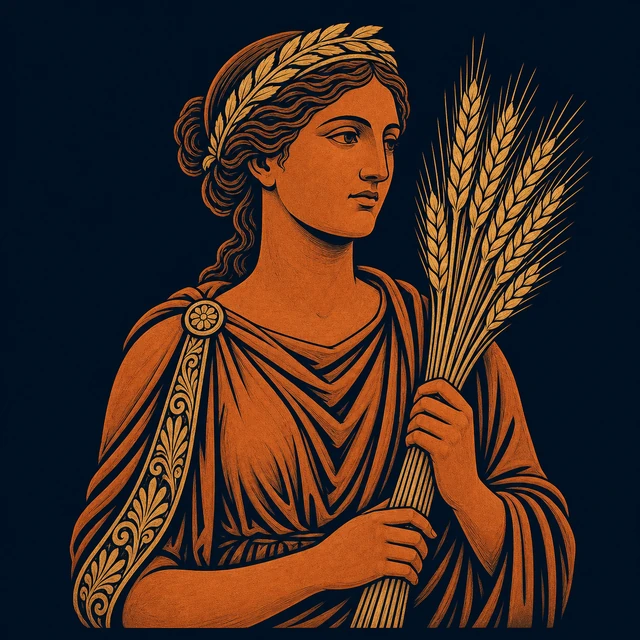
Demeter is a daughter of Rhea and Cronus. The Theogony numbers her among the six siblings swallowed by their father and later released in Zeus' succession reversal, placing an Olympian genealogy before her better-known mother-daughter story. In the Homeric Hymn to Demeter, after Persephone is taken by Hades, Demeter searches with torches, withdraws from Olympus and reaches Eleusis disguised as an old woman. She hides the seed in the earth, threatening humanity with famine and depriving the gods of offerings until Zeus negotiates her daughter's return. When Persephone can spend part of the year above, growth resumes and Demeter teaches rites to the rulers of Eleusis. Divine succession, agriculture, loss and reunion thus form one cross-story identity.
Key facts
Leaving Olympus to search
After learning that Persephone has been taken below, Demeter refuses Olympian life, travels to Eleusis in disguise and requires the community to establish her sanctuary.
Forcing negotiation through famine
Seasonal settlement of the Homeric Hymn to DemeterShe prevents seed from growing, threatening both humanity and divine offerings; only after Persephone receives a recurring return does Demeter restore the harvest and transmit her rites.
Famine forces divine negotiation
Demeter hides the seed and refuses Olympus until Zeus sends Hermes to bring Persephone back.
Further spoiler details are available in the interactive atlas.
Relationships
- Persephonemother of
Persephone is the daughter of Demeter.
- Rheamother of
Rhea is the mother of Demeter.
- Cronusfather of
Cronus is the father of Demeter.
- The Swallowing of the Childrenis swallowed in
Demeter is swallowed by Cronus after her birth.
Story appearances
- Birth of the GodsSwallowed divine sibling
Daughter of Rhea and Cronus, swallowed by her father at birth and later released with the other siblings.
- The TitanomachyOne of the released siblings
One of the released siblings within the struggle between the older Titans and Zeus' side.
- Olympian OrderFigure or event appearing in Olympian Order
Figure or event appearing in Olympian Order within the family, honours or council order that follows Zeus' victory.
- Gates of the UnderworldMother whose famine forces a response to her daughter’s loss
Mother whose famine forces a response to her daughter’s loss, part of the Underworld story's crossings, losses, judgments or guarded spaces.
Ancient sources
MythWeave distinguishes ancient-source evidence from later adaptations and modern interpretation.
- Homeric tradition, Homeric Hymns, Hymns to the gods
- Hesiod, Theogony, Complete poem
- Hesiod, Theogony, Lines 453–467: Rhea bears six children and Cronus swallows them because of the succession prophecy
- Hesiod, Theogony, Lines 492–506: Cronus releases the children, Zeus sets up the stone, frees the Cyclopes and receives thunder
- Hesiod, Theogony, Lines 468–491: Rhea seeks help, Zeus is hidden in Crete and a swaddled stone is substituted
- Pseudo-Apollodorus, Bibliotheca, 1.2.1: Metis' drug, ten-year war, Gaia's prophecy, Campe, three weapons, Titan imprisonment and division by lot
- Hesiod, Theogony, Lines 617–653: prolonged war, the Olympus and Othrys camps, Gaia's counsel to free the Hundred-Handers, and Zeus's invitation to fight
- Hesiod, Theogony, Lines 907–918: households of Eurynome, Demeter and Mnemosyne
- Hesiod, Theogony, Lines 1–115: the Muses, the poet's commission and the questions of divine origins
- Homeric tradition, Homeric Hymn 2 to Demeter, Lines 1–39: Persephone is taken and Hecate hears her cry
- Homeric tradition, Homeric Hymn 2 to Demeter, Lines 305–356: famine and Zeus sends Hermes below
- Homeric tradition, Homeric Hymn 2 to Demeter, Lines 357–433: pomegranate, escorted return and divided year
- Homeric tradition, Homeric Hymn 2 to Demeter, Lines 1–304: Persephone's removal, Demeter's search and Eleusis
- Homeric tradition, Homeric Hymn 2 to Demeter, Lines 305–495: famine, Persephone's return, the pomegranate and seasonal settlement