Hephaestus
God of fire and craft, maker of wondrous divine objects.
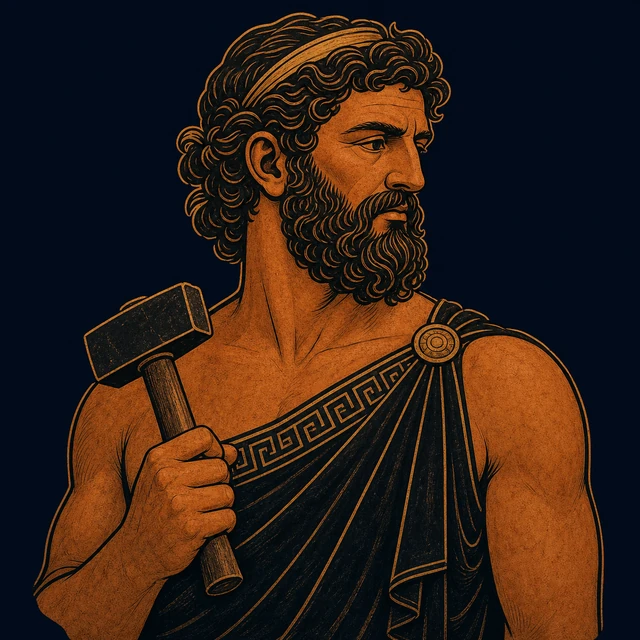
Overview
Hephaestus joins bodily difference, technical skill and divine power in one figure. The Theogony says that Hera bore him without Zeus and emphasizes that his craft surpasses that of the other heavenly children. In Iliad Book 1 he tries to calm Zeus and Hera and recalls being thrown from Olympus after helping his mother. Book 18 turns his workshop into a model of the cosmos: the new shield for Achilles contains cities, farming, dancing, war and Ocean. In Odyssey Book 8, the story of the invisible net shows the same intelligence in another register. Hephaestus overcomes Aphrodite and Ares through design rather than speed or force. Iliad 1 gives him a mediating role beyond craft: counsel, service and pouring drink restore the feast during conflict between Zeus and Hera.
Key facts
Forging a world upon a shield
After Thetis asks for new armour, Hephaestus works bronze, tin, gold and silver into Achilles' shield, placing celestial bodies, two cities, labour and Ocean across its layered surface.
A mechanism instead of direct combat
The minstrel's tale in Odyssey Book 8Demodocus' song tells how Hephaestus makes invisible bonds, traps Aphrodite and Ares in the act and summons the gods as witnesses.
Fashioning the first woman
Hephaestus fashions the first woman according to Zeus’s plan; Works and Days explicitly describes earth and water.
Further spoiler details are available in the interactive atlas.
Relationships
- Aphroditemarried to
The Odyssey's bard sings of their marriage, infidelity and the cunning net.
- Thetisasks for new armour
Thetis asks Hephaestus to forge armour for Achilles.
- Achillesforges new armour
Hephaestus forges new equipment including the shield’s cosmic scenes.
- Herabears independently
Hesiod says Hera bears Hephaestus without union amid strife with Zeus.
- Heramediates the quarrel
Hephaestus urges Hera not to let mortal affairs ruin the feast and takes up the serving of drink.
- Pandorafashions
Hephaestus fashions the first woman according to Zeus’s plan.
Story appearances
- The Trojan WarDivine smith enabling Achilles’ return
Answers Thetis by forging new armour including the cosmic shield.
- Olympian OrderFigure or event appearing in Olympian Order
Figure or event appearing in Olympian Order within the family, honours or council order that follows Zeus' victory.
Ancient sources
MythWeave distinguishes ancient-source evidence from later adaptations and modern interpretation.
- Homer, Iliad, Books 1–24
- Homer, Odyssey, Books 1–24
- Hesiod, Theogony, Lines 918–929: the families of Leto and Hera and the births of Athena and Hephaestus
- Homeric Hymn tradition, Homeric Hymn to Athena, Lines 1–15: Athena emerges armed from Zeus's head
- Homer, Iliad, Book 1.493–611: Thetis's petition, Zeus and Hera's quarrel and Hephaestus' mediation
- Homer, Odyssey, Book 1.26–95: the divine council discusses Odysseus's return
- Homer, Odyssey, Book 5.1–42: council decision and Zeus's commission to Hermes
- Hesiod, Theogony, Lines 561–616: fire withheld and stolen, the first woman and punishment
- Hesiod, Works and Days, Lines 59–82: the gods fashion and adorn the woman; Hermes gives voice and the name Pandora
- Homer, Iliad, Book 18.368–617: Hephaestus forges Achilles' armour and shield
- Homer, Odyssey, Book 8.266–366: Demodocus sings of Hephaestus' cunning net