Hera
Goddess of marriage and queen of Olympus.
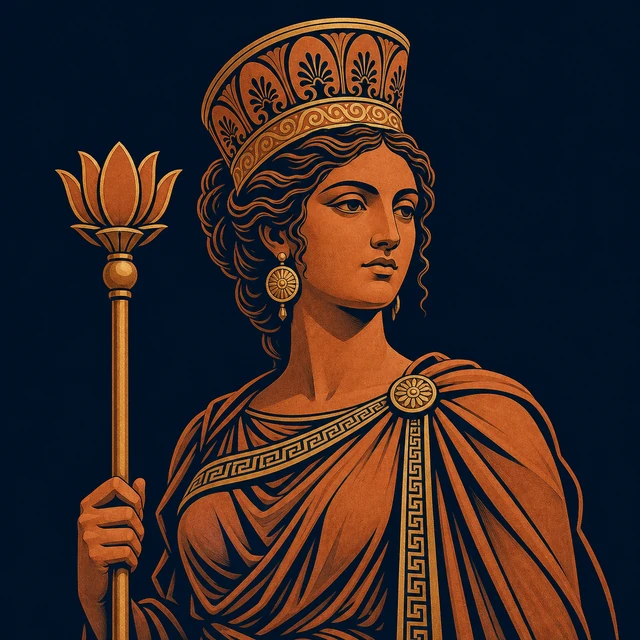
Overview
Hera is the wife of Zeus and queen of Olympus, but epic does not confine her to the protection of marriage. The Theogony places her at the centre of the Olympian genealogy as mother of Hebe, Ares and Eileithyia, and says that she bore the master craftsman Hephaestus without Zeus. In the Iliad her commitment to the Achaean cause repeatedly brings her into political conflict with Zeus. In Book 14 she borrows Aphrodite’s power of attraction and works with Sleep to distract Zeus, allowing Poseidon to aid the Greeks. Marriage, sovereignty and divine strategy therefore remain inseparable in her stories.
Key facts
The Olympian household in the Theogony
Hesiodic TheogonyHesiod calls Hera the last wife taken by Zeus and places Hebe, Ares, Eileithyia and the independently conceived Hephaestus within her genealogy.
Changing the battle through desire and sleep
Hera adorns herself and uses the help of Aphrodite and Sleep to deceive Zeus; while he sleeps, the Achaeans gain relief and divine assistance.
Seeking Medea for the Colchian crisis
After consulting Athena, Hera asks Aphrodite to make Medea desire Jason because they see no other way to gain the Fleece.
Further spoiler details are available in the interactive atlas.
Relationships
- Aresmother of
Hera is the mother of Ares.
- Zeusmarried to
Hesiod's Theogony names Hera as Zeus's wife.
- Paris Chooses Aphroditeoffers a reward
Hera offers rule as the reward for Paris choosing her.
- Rheamother of
Rhea is the mother of Hera.
- Cronusfather of
Cronus is the father of Hera.
- Zeussiblings
Zeus and Hera are children of Cronus and Rhea; the Theogony names Zeus as the youngest.
- The Swallowing of the Childrenis swallowed in
Hera is swallowed by Cronus after her birth.
- Hebemother of
Hera and Zeus are parents of Hebe.
- Eileithyiamother of
Hera and Zeus are parents of Eileithyia.
- Hephaestusbears independently
Hesiod says Hera bears Hephaestus without union amid strife with Zeus.
- Zeusquarrels over secret counsel
Hera detects Zeus's private counsel with Thetis and they quarrel in the divine house.
- Hephaestusmediates the quarrel
Hephaestus urges Hera not to let mortal affairs ruin the feast and takes up the serving of drink.
- Eurystheusadvances his birth and rule
Hera uses an oath and birth timing so Eurystheus receives rule first.
- Amazonsspreads a false abduction warning
Hera moves among the Amazons in disguise and claims strangers are abducting their queen.
- Cattle of Geryonscatters with a gadfly
On the return, Hera sends a gadfly that scatters the herd.
- Jasonplans to secure Medea’s aid
Hera judges that the Fleece cannot be gained without Medea and seeks intervention from the love goddess.
Story appearances
- The Trojan WarGoddess aligned with the Achaeans
After Paris does not choose her, she repeatedly supports the Achaeans and contests Zeus' decisions.
- Birth of the GodsDaughter of Rhea and Cronus
The goddess named in the proem becomes one of the six siblings, swallowed and later released.
- The TitanomachyOne of the released siblings
One of the released siblings within the struggle between the older Titans and Zeus' side.
- Olympian OrderHousehold centre and participant in council conflict
Household centre and participant in council conflict within the family, honours or council order that follows Zeus' victory.
- The Labours of HeraclesHera in the Labours
Hera enters this story through Heracles' labours; when other stories return to the figure, they follow that later setting.
- The ArgonautsHera in the Argonaut expedition
Hera enters this story through the Argonaut expedition; other versions are handled where their own episodes call for them.
Ancient sources
MythWeave distinguishes ancient-source evidence from later adaptations and modern interpretation.
- Homer, Iliad, Books 1–24
- Hesiod, Theogony, Complete poem
- Hesiod, Theogony, Lines 1–115: the Muses, the poet's commission and the questions of divine origins
- Hesiod, Theogony, Lines 453–467: Rhea bears six children and Cronus swallows them because of the succession prophecy
- Hesiod, Theogony, Lines 492–506: Cronus releases the children, Zeus sets up the stone, frees the Cyclopes and receives thunder
- Hesiod, Theogony, Lines 468–491: Rhea seeks help, Zeus is hidden in Crete and a swaddled stone is substituted
- Pseudo-Apollodorus, Bibliotheca, 1.2.1: Metis' drug, ten-year war, Gaia's prophecy, Campe, three weapons, Titan imprisonment and division by lot
- Hesiod, Theogony, Lines 617–653: prolonged war, the Olympus and Othrys camps, Gaia's counsel to free the Hundred-Handers, and Zeus's invitation to fight
- Hesiod, Theogony, Lines 918–929: the families of Leto and Hera and the births of Athena and Hephaestus
- Homeric Hymn tradition, Homeric Hymn to Athena, Lines 1–15: Athena emerges armed from Zeus's head
- Homer, Iliad, Book 1.493–611: Thetis's petition, Zeus and Hera's quarrel and Hephaestus' mediation
- Homer, Odyssey, Book 1.26–95: the divine council discusses Odysseus's return
- Homer, Odyssey, Book 5.1–42: council decision and Zeus's commission to Hermes
- Homer, Iliad, Book 19.95–133: Hera manipulates the births so Eurystheus receives rule first
- Pseudo-Apollodorus, Bibliotheca, 2.4.12: purification, Delphic command, service and the initial ten tasks
- Pseudo-Apollodorus, Bibliotheca, 2.5.1: the invulnerable lion, cave tactic and delivery of its skin
- Pseudo-Apollodorus, Bibliotheca, 2.5.9: Hippolyta offers the belt, Hera spreads a false report and conflict follows
- Pseudo-Apollodorus, Bibliotheca, 2.5.10: Helios’ cup, Erytheia, Geryon’s cattle and Hera’s gadfly
- Apollonius Rhodius, Argonautica, Book 1.1–22: one-sandal oracle, Pelias and the Fleece command
- Pindar, Pythian 4, Lines 125–299: one-sandal oracle, Chiron and Pelias’ Fleece bargain
- Apollonius Rhodius, Argonautica, Book 3.6–110: Hera, Athena, Aphrodite and Eros plan
- Apollonius Rhodius, Argonautica, Book 3.471–1162: Medea deliberates, meets Jason and provides charm and instructions
- Hesiod, Theogony, Lines 901–929: Zeus and Hera, Ares and Hephaestus in the divine genealogy
- Homer, Iliad, Book 14.153–353: Hera's deception of Zeus