Aphrodite
Aphrodite is the goddess of love whose promise to Paris helps set the Trojan War in motion.
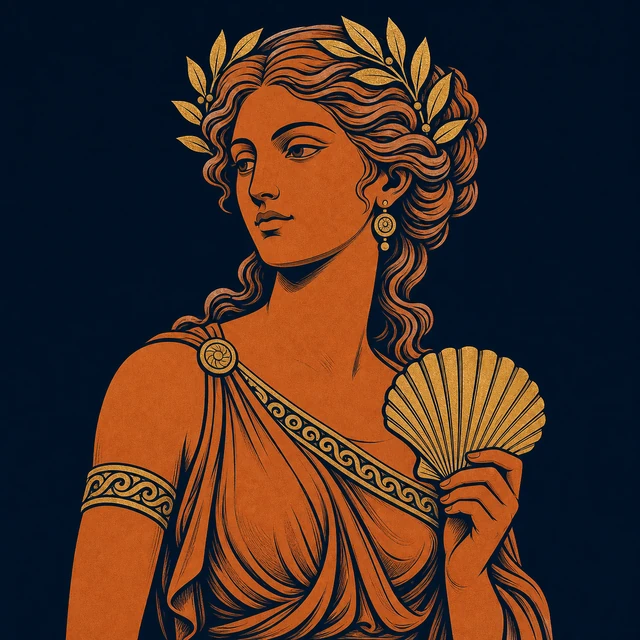
Overview
Aphrodite governs desire, attraction and union, but ancient texts do not agree on her birth. Hesiod's Theogony brings her from sea foam around Uranus's severed genitals cast into the sea, by way of Cythera to Cyprus; Iliad Book 5 separately calls her Zeus's daughter and treats Dione as her mother. During the Trojan War she protects Paris, Aeneas and Helen, yet protection is not always gentle care. In Book 3 she removes the defeated Paris from his duel, then threatens Helen when Helen refuses to return to his room. Aphrodite's power can create bonds, exert coercion and redirect the course of war. The Homeric Hymn to Aphrodite defines the boundary of her power through Athena, Artemis and Hestia, whom she cannot master, rather than supplying a Twelve Olympians roster.
Key facts
Foam-born goddess and daughter of Zeus
Hesiodic and Homeric birth traditionsThe Theogony explains her name and Cyprian titles through a birth from sea foam; Iliad Book 5 has the wounded goddess seek her mother Dione, preserving a different divine genealogy.
Rescuing Paris and coercing Helen
When Menelaus gains the advantage in the duel, Aphrodite removes Paris to his chamber; when Helen refuses to follow, the goddess threatens to withdraw favour and stir destructive hatred.
Three goddesses beyond her power
The hymn says Aphrodite cannot persuade or deceive the hearts of Athena, Artemis and Hestia.
Enlisting Eros against Medea
Aphrodite accepts Hera and Athena’s request and uses a gift to persuade Eros to shoot Medea.
Relationships
- Hephaestusmarried to
The Odyssey's bard sings of their marriage, infidelity and the cunning net.
- Trojan Warbacks Troy
Aphrodite protects the Trojans and Helen.
- Paris Chooses Aphroditeoffers a reward
Aphrodite offers Helen as the reward for Paris choosing her.
- Parispromises Helen
Aphrodite promises Paris the hand of Helen.
- Parisprotects
Aphrodite supports her promise and removes Paris from danger in the duel.
- Helencoerces toward Paris
When Helen resists returning to Paris, Aphrodite threatens hatred and death.
- Diomedeswounds
With Athena’s permission, Diomedes wounds Aphrodite while she rescues Aeneas.
- Aeneasrescues her son
Aphrodite attempts to carry the wounded Aeneas from battle.
- Uranussevered part leads to birth
Hesiod connects Uranus’s severed genitals cast into the sea with Aphrodite’s emergence from foam.
- Erosaccompanies at emergence
Eros accompanies Aphrodite as she emerges from the foam and enters the company of the gods.
- Erosasks him to shoot Medea
Aphrodite uses a promised gift to persuade Eros to shoot Medea.
- Dionemother of
Iliad 5 has the wounded Aphrodite turn to Dione as her mother.
- Zeusfather of
Iliad 5 calls Aphrodite a daughter of Zeus, differing from Hesiod's foam-birth account.
Story appearances
- The Trojan WarProtector of Paris and Trojan figures
Promises Helen, rescues Paris and Aeneas, and also coerces Helen.
- Birth of the GodsGoddess with disputed birth traditions
Named first in the proem, she later receives Hesiod’s foam-birth account with Homeric parentage clearly separated.
- Olympian OrderGoddess whose sphere defines the Hestia passage
Goddess whose sphere defines the Hestia passage within the family, honours or council order that follows Zeus' victory.
- The ArgonautsAphrodite in the Argonaut expedition
Aphrodite enters this story through the Argonaut expedition; other versions are handled where their own episodes call for them.
Ancient sources
MythWeave distinguishes ancient-source evidence from later adaptations and modern interpretation.
- Homer, Iliad, Books 1–24
- Hesiod, Theogony, Complete poem
- Hesiod, Theogony, Lines 1–115: the Muses, the poet's commission and the questions of divine origins
- Hesiod, Theogony, Lines 173–206: Aphrodite's foam birth
- Homer, Iliad, Book 5.370–380: Aphrodite appeals to her mother Dione after being wounded
- Homer, Iliad, Book 5.130–132: Aphrodite is called the daughter of Zeus
- Homeric Hymn tradition, Homeric Hymn to Aphrodite, Lines 1–32: three exempt goddesses and Hestia's oath and honour
- Apollonius Rhodius, Argonautica, Book 3.6–110: Hera, Athena, Aphrodite and Eros plan
- Apollonius Rhodius, Argonautica, Book 3.471–1162: Medea deliberates, meets Jason and provides charm and instructions
- Homer, Iliad, Book 3: Helen at the wall, Menelaus' duel and Aphrodite's intervention