Eurystheus
The Mycenaean ruler who commands the labours and controls which tasks count.
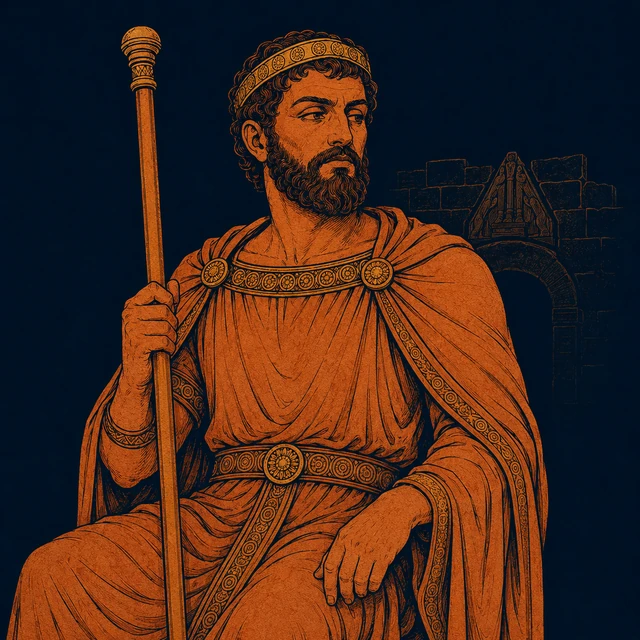
Overview
Eurystheus exercises power through commands and through the authority to decide what counts. Homer traces his rule to Hera’s manipulation of birth order, while Pseudo-Apollodorus sends Heracles into his service through the Delphic command. By rejecting the Hydra and Augean tasks because of help and payment, he turns an initial programme of ten into the familiar twelve.
Key facts
Rule secured before Heracles
Hera exploits Zeus’ oath so Eurystheus is born first and receives the promised rule.
Two completed tasks rejected
He excludes the Hydra because Iolaus helped and the stables because Heracles worked for a promised reward.
Relationships
- Labours of Heraclescommands and counts the Labours
Eurystheus issues tasks and determines which results count.
- Heraadvances his birth and rule
Hera uses an oath and birth timing so Eurystheus receives rule first.
- Heraclescommands service and labours
Following the Delphic direction, Heracles serves Eurystheus and receives the tasks.
- Labours of Heraclesrejects the Hydra labour
Eurystheus refuses to count the second task because Iolaus helped.
- Labours of Heraclesrejects the paid labour
Eurystheus rules that work undertaken for payment cannot count.
- Cretan Bullreleases after display
Eurystheus releases the delivered bull, which later roams to Marathon.
- Heraclesdelivers the recovered herd
Heracles delivers the recovered cattle to Eurystheus.
- Heraclesdisplays the hound
Heracles brings Cerberus before Eurystheus for display.
Story appearances
- The Labours of HeraclesEurystheus in the Labours
Eurystheus enters this story through Heracles' labours; when other stories return to the figure, they follow that later setting.
Ancient sources
MythWeave distinguishes ancient-source evidence from later adaptations and modern interpretation.
- Homer, Iliad, Book 19.95–133: Hera manipulates the births so Eurystheus receives rule first
- Pseudo-Apollodorus, Bibliotheca, 2.4.12: purification, Delphic command, service and the initial ten tasks
- Pseudo-Apollodorus, Bibliotheca, 2.5.1: the invulnerable lion, cave tactic and delivery of its skin
- Pseudo-Apollodorus, Bibliotheca, 2.5.2: regrowing heads, Iolaus and fire, poison and rejection
- Pseudo-Apollodorus, Bibliotheca, 2.5.3: year-long pursuit, live capture and Artemis’ challenge
- Pseudo-Apollodorus, Bibliotheca, 2.5.5: reward bargain, river diversion, refusal and second rejection
- Pseudo-Apollodorus, Bibliotheca, 2.5.7: bull variants, live capture, display, release and Marathon aftermath
- Pseudo-Apollodorus, Bibliotheca, 2.5.8: man-eating mares, Abderus’ death, defeat of the Thracian king and delivery
- Pseudo-Apollodorus, Bibliotheca, 2.5.9: Hippolyta offers the belt, Hera spreads a false report and conflict follows
- Pseudo-Apollodorus, Bibliotheca, 2.5.10: Helios’ cup, Erytheia, Geryon’s cattle and Hera’s gadfly
- Pseudo-Apollodorus, Bibliotheca, 2.5.11: Prometheus’ advice, Atlas’ burden, counter-ruse and return of the apples
- Diodorus Siculus, Library of History, 4.25.1–4.26.4: Cerberus eleventh, apples last, and alternative apple accounts
- Pseudo-Apollodorus, Bibliotheca, 2.5.12: Taenarum, Hades’ condition, unarmed mastery, display and return
- Euripides, Heracles, Lines 1–25: the family awaits Heracles as he completes the Cerberus task
- Euripides, Heracles, Lines 815–1015: Iris and Lyssa bring madness after the hero returns