Ares
God of the violent and frenzied face of war.
Overview
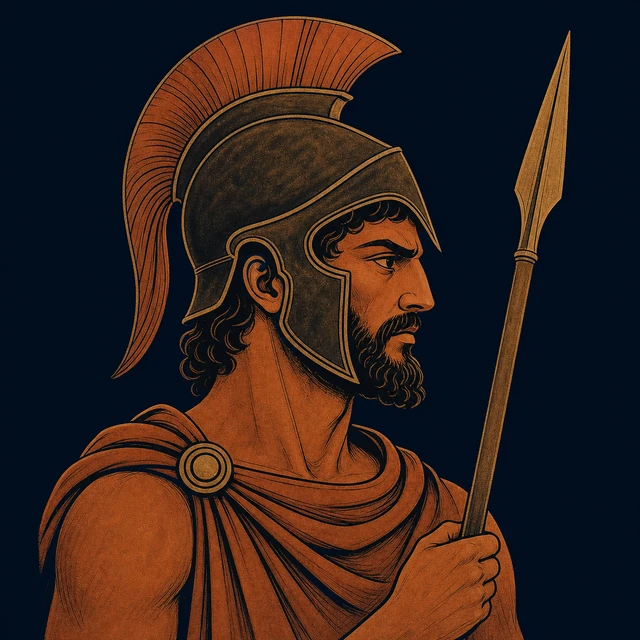
In the Iliad Ares embodies war at its most immediate, violent and unstable. The Theogony names him as a son of Zeus and Hera, but on the epic battlefield he is no abstraction: he charges with a spear, changes allegiance, suffers wounds and complains to Zeus. In Book 5 he fights for Troy until Athena mounts Diomedes' chariot and guides the mortal spear that wounds him. The encounter makes Ares a deliberate contrast with Athena. Both belong to warfare, but Ares expresses shock, impulse and bodily violence, while Athena supplies recognition, strategy and control of the battle.
Key facts
Son of Zeus and Hera
Hesiodic TheogonyHesiod lists Ares with Hebe and Eileithyia among the children of Zeus and Hera, placing him within the central Olympian household.
Even a war god can be wounded
Athena encourages Diomedes to attack Ares and guides the weapon herself; the wounded war god cries out like a vast army and retreats to Olympus.
Relationships
- Zeusfather of
Ares is the son of Zeus and Hera.
- Heramother of
Hera is the mother of Ares.
- Athenaopposes in battle
The two war gods support opposing sides at Troy.
- Trojan Warenters battle
Ares repeatedly enters mortal combat directly.
- Diomedeswounds with Athena
Athena guides Diomedes’ spear into Ares.
Story appearances
- The Trojan WarWounded and unstable god of battle
Fights for Troy but is wounded by Diomedes under Athena’s guidance.
- Olympian OrderFigure or event appearing in Olympian Order
Figure or event appearing in Olympian Order within the family, honours or council order that follows Zeus' victory.
Ancient sources
MythWeave distinguishes ancient-source evidence from later adaptations and modern interpretation.
- Homer, Iliad, Books 1–24
- Hesiod, Theogony, Lines 918–929: the families of Leto and Hera and the births of Athena and Hephaestus
- Homeric Hymn tradition, Homeric Hymn to Athena, Lines 1–15: Athena emerges armed from Zeus's head
- Hesiod, Theogony, Lines 901–929: Zeus and Hera, Ares and Hephaestus in the divine genealogy
- Homer, Iliad, Book 5: Diomedes' aristeia and the wounding of Aphrodite and Ares