Apollo
God of prophecy, music and archery.
Overview
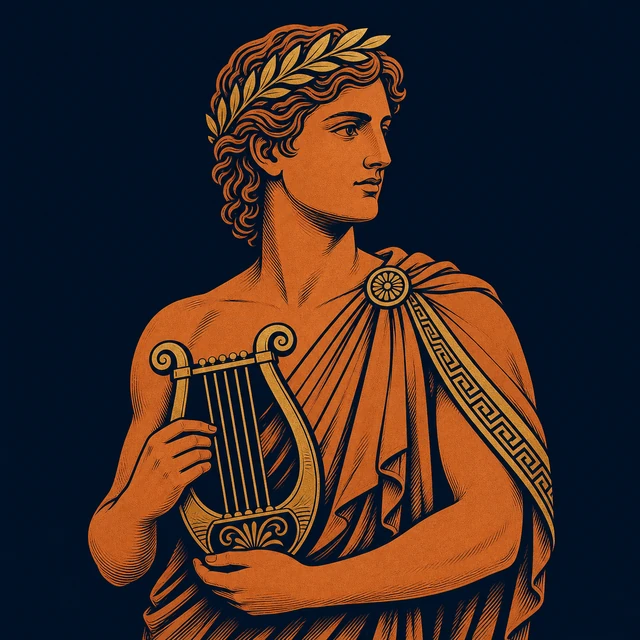
Apollo, son of Zeus and Leto and sibling of Artemis, combines powers that modern categories often separate: archery, music and prophecy. The Homeric Hymn to Apollo locates his birth on Delos. As soon as he tastes divine food, he claims the curved bow, the lyre and the declaration of Zeus’ will, before establishing his oracular centre beneath Parnassus. The Iliad opens with a more dangerous expression of the same far-reaching power. When Agamemnon dishonours the priest Chryses, Apollo strikes the Achaean camp with plague. His support for Troy makes prophecy, protection and destruction part of the same divine force.
Key facts
From Delos to Delphi
Homeric Hymn to ApolloThe hymn narrates Apollo's birth to Leto on Delos, his claim to bow, lyre and prophecy, and his search for the Delphic sanctuary from which to answer mortals.
Plague for a dishonoured priest
After Chryses' appeal for his daughter is rejected, Apollo hears the priest's prayer and sends days of pestilence through the Achaean camp with his far-reaching shafts.
Relationships
- Zeusfather of
Apollo is the son of Zeus and Leto.
- Artemistwins
Apollo and Artemis are the divine twins of Leto.
- Trojan Warbacks Troy
Apollo aids Troy on the battlefield.
- Chrysesserves as priest
Chryses prays as Apollo’s priest for an answer to his dishonour.
- Apollo’s Plaguesends
Apollo answers his priest by sending plague into the Achaean camp.
- Aeneastakes over protection
After Aphrodite is wounded, Apollo protects and restores Aeneas.
- Patroclusstrips armour and strength
Apollo strikes Patroclus from behind, stripping his armour and resistance.
- Parishelps kill Achilles
Pseudo-Apollodorus names Apollo with Paris as an agent of Achilles’ death.
- Letomother of
Leto bears Apollo to Zeus.
- Hestiaseeks marriage
The hymn says Apollo seeks marriage with Hestia.
- Asclepiusfather of
Apollo is the father of Asclepius.
Story appearances
- The Trojan WarGod answering his priest and protecting Trojans
Punishes the Achaean camp, protects Aeneas and strips Patroclus’ strength; Pseudo-Apollodorus also names him in Achilles’ death.
- Birth of the GodsFamiliar deity in the proem
One of the familiar gods sung by the Muses; his birth story returns later in the Olympian households.
- Olympian OrderFigure or event appearing in Olympian Order
Figure or event appearing in Olympian Order within the family, honours or council order that follows Zeus' victory.
Ancient sources
MythWeave distinguishes ancient-source evidence from later adaptations and modern interpretation.
- Homer, Iliad, Books 1–24
- Homeric tradition, Homeric Hymns, Hymns to the gods
- Hesiod, Theogony, Lines 1–115: the Muses, the poet's commission and the questions of divine origins
- Hesiod, Theogony, Lines 918–929: the families of Leto and Hera and the births of Athena and Hephaestus
- Homeric Hymn tradition, Homeric Hymn to Apollo, Lines 1–15: Apollo enters Zeus's house and Leto receives her son
- Homeric Hymn tradition, Homeric Hymn to Aphrodite, Lines 1–32: three exempt goddesses and Hestia's oath and honour
- Homer, Iliad, Book 1.493–611: Thetis's petition, Zeus and Hera's quarrel and Hephaestus' mediation
- Homer, Odyssey, Book 1.26–95: the divine council discusses Odysseus's return
- Homer, Odyssey, Book 5.1–42: council decision and Zeus's commission to Hermes
- Homeric tradition, Homeric Hymn 3 to Apollo, Lines 1–546: birth on Delos, bow, lyre, prophecy and the Delphic oracle
- Homer, Iliad, Book 1: Apollo's plague, the quarrel and Hephaestus' mediation