Artemis
Goddess of the hunt and twin sister of Apollo.
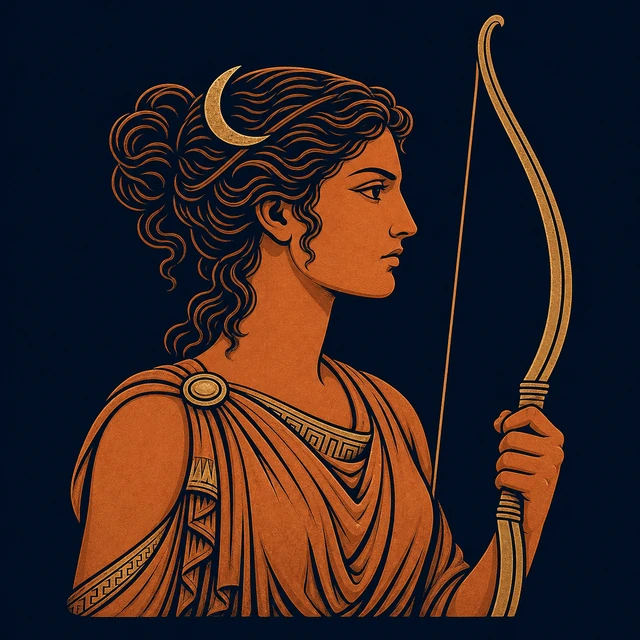
Overview
Artemis is the daughter of Zeus and Leto and the sibling of Apollo. In only twenty lines, Homeric Hymn 27 joins two sides of her identity. She draws her golden bow across hills and forests, cheering on the hounds and hunting wild animals; once satisfied, she travels to Apollo's Delphic house and leads the Muses and Graces in dance. She is therefore not simply an isolated wilderness deity, but also a figure of maiden groups, music and ordered performance. Odyssey Book 6 compares Nausicaa among her attendants to Artemis rising above the mountain nymphs, making the goddess a visual model of youth and group leadership.
Key facts
Leading the dance after the hunt
The hymn first sends Artemis hunting through the mountains, then has her hang up bow and arrows and lead the Muses and Graces in song and dance at Apollo's house.
The divine simile for Nausicaa
As Nausicaa plays among her attendants, the poet compares her to Artemis moving among mountain nymphs, emphasizing the maiden's stature and leading place.
Relationships
- Zeusfather of
Artemis is the daughter of Zeus and Leto.
- Apollotwins
Apollo and Artemis are the divine twins of Leto.
- Aulisbecalms the fleet at
Pseudo-Apollodorus links the second calm at Aulis to Artemis.
- Letomother of
Leto bears Artemis to Zeus.
- Ceryneian Hindprotects her sacred hind
The hind belongs to Artemis, placing its capture under a sacred limit.
- Heraclesallows passage after his plea
After hearing that Eurystheus bears responsibility, Artemis allows the hind to be carried onward.
Story appearances
- The Trojan WarGoddess controlling departure from Aulis
The second calm and Iphigenia’s fate are both attached to her.
- Birth of the GodsFamiliar deity in the proem
One of the familiar gods sung by the Muses; her birth story returns later in the Olympian households.
- Olympian OrderFigure or event appearing in Olympian Order
Figure or event appearing in Olympian Order within the family, honours or council order that follows Zeus' victory.
- The Labours of HeraclesArtemis in the Labours
Artemis enters this story through Heracles' labours; when other stories return to the figure, they follow that later setting.
Ancient sources
MythWeave distinguishes ancient-source evidence from later adaptations and modern interpretation.
- Homer, Odyssey, Books 1–24
- Homeric tradition, Homeric Hymns, Hymns to the gods
- Hesiod, Theogony, Lines 1–115: the Muses, the poet's commission and the questions of divine origins
- Hesiod, Theogony, Lines 918–929: the families of Leto and Hera and the births of Athena and Hephaestus
- Homeric Hymn tradition, Homeric Hymn to Apollo, Lines 1–15: Apollo enters Zeus's house and Leto receives her son
- Homeric Hymn tradition, Homeric Hymn to Aphrodite, Lines 1–32: three exempt goddesses and Hestia's oath and honour
- Pseudo-Apollodorus, Bibliotheca, 2.5.3: year-long pursuit, live capture and Artemis’ challenge
- Homeric tradition, Homeric Hymn 27 to Artemis, Lines 1–20: golden arrows, hunting, Apollo and the Muses
- Homer, Odyssey, Books 6–8: Nausicaa and the Phaeacian court