Styx
The Oceanid who first answers Zeus’s call and becomes the oath of the gods.
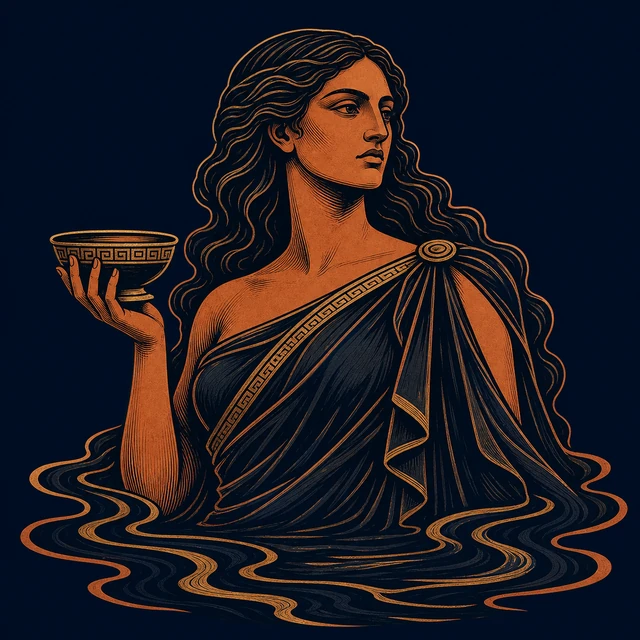
Overview
Styx is a daughter of Oceanus and Tethys and the first goddess to come with her children when Zeus publicly calls for allies. The poem places her action within her father’s counsel and the open summons; Zeus consequently makes Styx the gods’ great oath and keeps her four children beside him. Later Underworld geography also uses the name Styx, but the oath goddess, the river and the whole realm of the dead are not identical concepts.
Key facts
An Oceanid goddess
Styx is listed among the daughters of Oceanus and Tethys in the great Oceanid branch.
First ally and divine oath
She first answers Zeus’s summons; he makes her the oath of the gods and keeps her children beside him.
Four children remain beside Zeus
Styx comes first with Zelus, Nike, Kratos and Bia, who consequently remain beside Zeus.
A deep boundary, not the whole map
Hesiod describes the feared dwelling of Styx near the Tartarean sequence without making the two the same place.
Relationships
- Oceanusfather of
Oceanus is the father of Styx.
- Tethysmother of
Tethys is the mother of Styx.
- Zeusfirst supports
Styx is the first to come after Zeus calls for allies.
- Nikemother of
Styx is mother of Nike.
- Kratosmother of
Styx is mother of Kratos.
- Biamother of
Styx is mother of Bia.
- Zelusmother of
Styx is mother of Zelus.
- Zeusgrants the honour of oath
Zeus makes Styx the great oath of the gods.
- Tartarusappears in the same deep-world sequence
Hesiod places Styx, Tartarus and other boundaries within the same poetic sequence of the world below.
- Cocytusis a branch of
Circe explicitly calls Cocytus a branch of Styx.
Story appearances
- Birth of the GodsOceanid first to answer Zeus
She first answers Zeus’s call on her father’s counsel and consequently becomes the oath of the gods.
- The TitanomachyFirst ally responding with her children
First ally responding with her children within the struggle between the older Titans and Zeus' side.
- Gates of the UnderworldBoundary power in Hesiod’s depths and Circe’s river route
Boundary power in Hesiod’s depths and Circe’s river route, part of the Underworld story's crossings, losses, judgments or guarded spaces.
Ancient sources
MythWeave distinguishes ancient-source evidence from later adaptations and modern interpretation.
- Hesiod, Theogony, Lines 337–403: selected Titan descendants, Styx's support for Zeus and the honours that follow
- Hesiod, Theogony, Lines 383–403: the four children of Pallas and Styx, Styx first answering Zeus and the honours that follow
- Pseudo-Apollodorus, Bibliotheca, 1.2.3–5: Menoetius struck during the war with the Titans and Styx with her children fighting for Zeus
- Hesiod, Theogony, Lines 736–806: Tartarus' depth, bronze enclosure, gates and threshold
- Hesiod, Theogony, Lines 807–819: the Titans dwelling beyond the gates and the later stations of Cottus, Gyes and Briareus
- Homer, Odyssey, Book 10.487–540: Circe’s command and the route toward Acheron