Oceanus
The world-encircling Titan river; Hesiod lists a Calypso among his daughters.
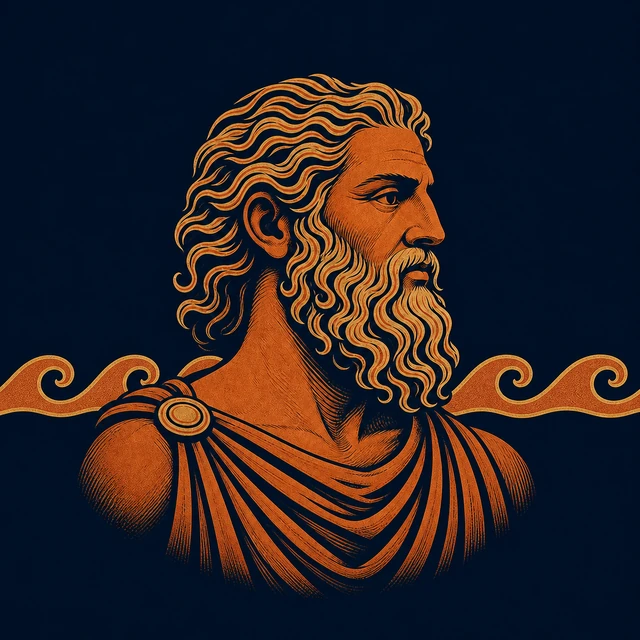
Overview
Oceanus is the Titan son of Gaia and Uranus who, in Hesiod’s branches, fathers rivers and many daughters with Tethys. This account selects Styx and an Oceanid named Calypso; the Ogygian Calypso of the Odyssey is instead daughter of Atlas, and the ancient evidence does not settle whether they are one goddess with variants or namesakes. Iliad 14 separately calls Oceanus the origin of the gods, preserved as an attributed alternative rather than used to rewrite Hesiod’s sequence beginning with Chaos.
Key facts
The branch with Tethys
Oceanus and Tethys produce rivers and daughters; Hesiod’s catalogue includes Styx and a Calypso.
Homer’s origin of the gods
Homeric Iliad traditionIliad 14 calls Oceanus the origin of the gods, a formulation distinct from Hesiod’s opening sequence.
Relationships
- Tethyssiblings
Oceanus and Tethys are Titan siblings, both children of Gaia and Uranus.
- Gaiamother of
Gaia is the mother of Oceanus.
- Uranusfather of
Uranus is the father of Oceanus.
- Tethysconsort with
Oceanus and Tethys together form the river and Oceanid branches.
- Styxfather of
Oceanus is the father of Styx.
- Calypsofather in Hesiod’s catalogue
Hesiod lists a Calypso as daughter of Oceanus and Tethys, while the Ogygian Calypso of the Odyssey is daughter of Atlas.
Story appearances
- Birth of the GodsTitan river and father of many waters
With Tethys he fathers Styx and the Calypso named by Hesiod; Homer separately uses language of him as the gods’ origin.
- The TitanomachyFather counselling Styx to respond
Father counselling Styx to respond within the struggle between the older Titans and Zeus' side.
Ancient sources
MythWeave distinguishes ancient-source evidence from later adaptations and modern interpretation.
- Hesiod, Theogony, Lines 126–153: Gaia brings forth Sky, Mountains and Sea, then the children of Gaia and Uranus
- Hesiod, Theogony, Lines 337–403: selected Titan descendants, Styx's support for Zeus and the honours that follow
- Homer, Iliad, Book 14.201 and 14.246: Oceanus is called the source of the gods or of all things
- Homer, Odyssey, Book 7.245–260: Calypso of Ogygia is called the daughter of Atlas
- Hesiod, Theogony, Lines 383–403: the four children of Pallas and Styx, Styx first answering Zeus and the honours that follow
- Pseudo-Apollodorus, Bibliotheca, 1.2.3–5: Menoetius struck during the war with the Titans and Styx with her children fighting for Zeus