Tartarus
The primordial dark region set deep beneath Earth.
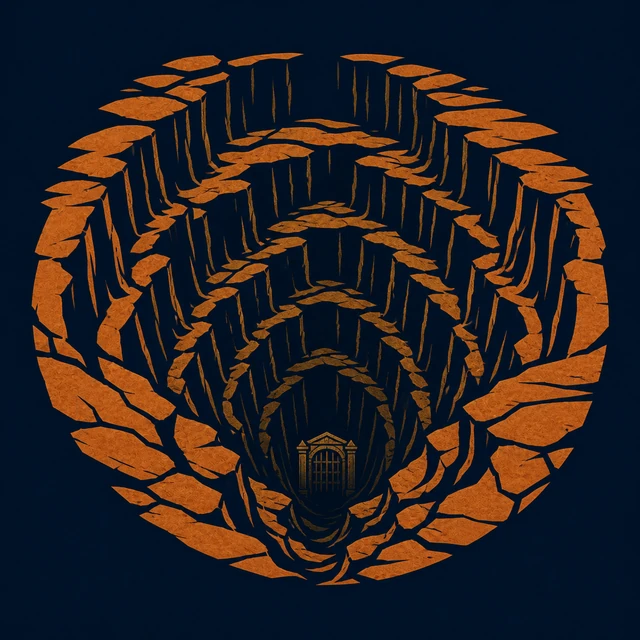
Overview
Ancient traditions can also personify cosmic regions, but the present passage does not require a second figure with the same name. The Titanomachy turns the primordial depth into a geography of confinement: bronze enclosure, gates and immovable threshold surround the place of the defeated Titans.
Key facts
Place in the primordial sequence
Tartarus appears after Gaia and before Eros in Hesiod’s compact sequence of first powers.
Deep beneath Earth
The poem sets Tartarus deep beneath broad Earth; this entry treats it first as a place without assuming personal action.
Not a synonym for the whole Underworld
Hesiod places Tartarus, Styx, Sleep, Death and Hades’ house in a related but non-identical far-below sequence.
Further spoiler details are available in the interactive atlas.
Relationships
- Gaialies deep within
Tartarus lies deep beneath broad Earth.
- Titansconfined in the depths
The defeated Titans are confined in Tartarus beyond the bronze gates.
- Typhoeusfather of
Tartarus fathers Typhoeus with Gaia.
- Typhoeuscast into the depths
Hesiod says Zeus casts Typhoeus into broad Tartarus.
- Styxappears in the same deep-world sequence
Hesiod places Styx, Tartarus and other boundaries within the same poetic sequence of the world below.
- Echidnafather of
The Pseudo-Apollodorus route presents Echidna as a daughter of Tartarus and Gaia.
Story appearances
- Birth of the GodsPrimordial region beneath Earth
One of the first powers located deep beneath Earth, later returning as the deep prison of defeated powers.
- The TitanomachyCosmic depth confining the defeated
Cosmic depth confining the defeated within the struggle between the older Titans and Zeus' side.
- Olympian OrderFather of Typhoeus and depth of confinement
Father of Typhoeus and depth of confinement within the family, honours or council order that follows Zeus' victory.
- Gates of the UnderworldDeep prison distinguished from the whole Underworld
Deep prison distinguished from the whole Underworld, part of the Underworld story's crossings, losses, judgments or guarded spaces.
Ancient sources
MythWeave distinguishes ancient-source evidence from later adaptations and modern interpretation.
- Hesiod, Theogony, Lines 116–125: Chaos, Gaia, Tartarus, Eros and the first generations
- Pseudo-Apollodorus, Bibliotheca, 1.2.1: Metis' drug, ten-year war, Gaia's prophecy, Campe, three weapons, Titan imprisonment and division by lot
- Hesiod, Theogony, Lines 617–653: prolonged war, the Olympus and Othrys camps, Gaia's counsel to free the Hundred-Handers, and Zeus's invitation to fight
- Hesiod, Theogony, Lines 687–735: Zeus' thunder, cosmic upheaval, three hundred stones, and the Titans defeated and bound
- Hesiod, Theogony, Lines 736–806: Tartarus' depth, bronze enclosure, gates and threshold
- Hesiod, Theogony, Lines 807–819: the Titans dwelling beyond the gates and the later stations of Cottus, Gyes and Briareus
- Hesiod, Theogony, Lines 820–852: Typhoeus is born and threatens Zeus's rule
- Hesiod, Theogony, Lines 853–885: Typhoeus defeated, Zeus chosen as king and honours distributed
- Pseudo-Apollodorus, Bibliotheca, 1.6.3: divine flight, Zeus's sinews and the Etna account