Sirens
Mysterious singers whose voices lure sailors to destruction.
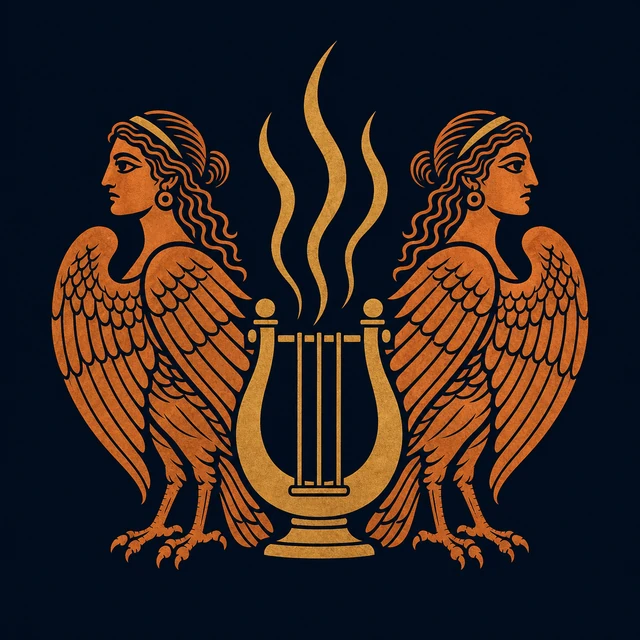
Overview
The Sirens threaten not through beautiful sound alone but by offering knowledge as bait. They address Odysseus by name and claim to know everything suffered by Greeks and Trojans in the war, as well as what happens across the earth. Circe's solution has the crew seal their ears with beeswax and bind the listening Odysseus to the mast, tightening the ropes even when he begs for release. Only after the ship passes are the bonds removed. Homer's text describes decaying bodies and bones around their meadow but does not prescribe the later fixed form of bird-women or mermaids; those later images should not be treated as the only ancient form.
Key facts
They promise knowledge, not romance
Song in Odyssey Book 12Their song offers knowledge of Troy and the world, targeting Odysseus' desire as witness and storyteller.
Restraint chosen in advance
Odysseus arranges ropes and orders while clear-minded, authorising the untempted crew to resist his later commands.
Song countered by Orpheus
When the Sirens attract the crew, Orpheus overlays their call with faster lyre-song and keeps most aboard.
Relationships
Story appearances
- The Odyssey HomecomingSingers who tempt sailors with knowledge
The Sirens draw Odysseus with a song promising knowledge of Troy and the world.
- The ArgonautsSirens in the Argonaut expedition
Sirens enters this story through the Argonaut expedition; other versions are handled where their own episodes call for them.
Ancient sources
MythWeave distinguishes ancient-source evidence from later adaptations and modern interpretation.
- Homer, Odyssey, Books 1–24
- Apollonius Rhodius, Argonautica, Book 4.294–551: Apsyrtus pursues, is lured and killed
- Apollonius Rhodius, Argonautica, Book 4.552–981: Zeus’ storm, Circe’s purification, Sirens and strait hazards
- Apollonius Rhodius, Argonautica, Book 4.982–1169: Colchian reclamation and the marriage decision
- Apollonius Rhodius, Argonautica, Book 4.1170–1637: Syrtes, carrying Argo and Triton’s guidance
- Apollonius Rhodius, Argonautica, Book 4.1638–1781: Talos, Anaphe and return to Pagasae
- Homer, Odyssey, Book 12: Sirens, sea monsters and the cattle of Helios