Svipdag
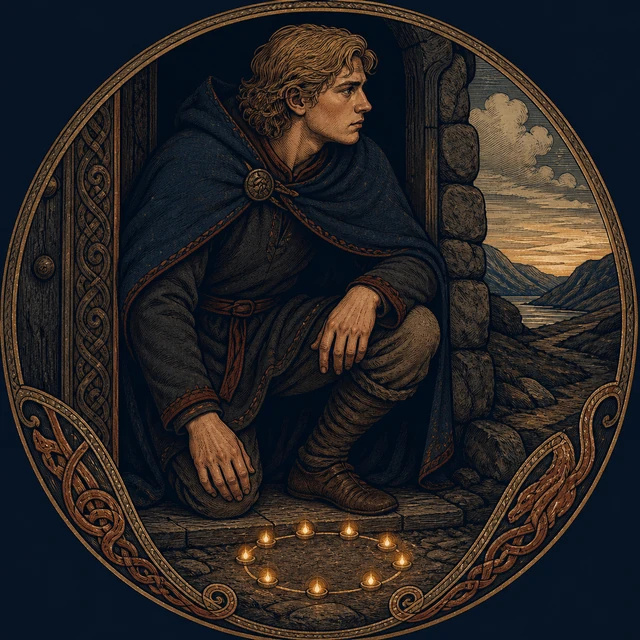
The young man sent by an unnamed stepmother to seek Mengloth, who first asks for charms at his mother’s grave and then answers at the fire-ringed hall.
Overview
Svipdag’s story is read by joining two poems preserved in late paper manuscripts. An unnamed stepmother sends him to find Mengloth; he wakes his dead mother Groa and receives nine protective charms. The next poem places him straight before a fire-ringed hall. No journey survives between them, so this account does not invent one. At the end, the gatekeeper acknowledges his name and Mengloth says that she has been waiting.
Key facts
An errand without a named giver
Svipdag says that his stepmother has ordered him to find Mengloth, but gives neither her name nor her reason for the command.
A name changes the final exchange
Near the end Fjolsvith recognizes the visitor as Svipdag; only then does Mengloth speak of her waiting.
Relationships
Story appearances
- Svipdagsmol: Charms, the Gate, and RecognitionFigure in the Svipdagsmol composite reading
The young man sent by an unnamed stepmother to seek Mengloth, who first asks for charms at his mother’s grave and then answers at the fire-ringed hall.
Ancient sources
MythWeave distinguishes ancient-source evidence from later adaptations and modern interpretation.
- Anonymous; translated by Henry Adams Bellows, The Poetic Edda: Svipdagsmol, Introduction: Grougaldr and Fjolsvinnsmol survive only in paper manuscripts no earlier than the seventeenth century; their union is an editorial arrangement and connecting stanzas may be lost.
- Anonymous; translated by Henry Adams Bellows, The Poetic Edda: Grougaldr, Stanzas 1–16: Svipdag wakes his dead mother Groa, says an unnamed stepmother has sent him to seek Mengloth, and Groa speaks nine charms for him.
- Anonymous; translated by Henry Adams Bellows, The Poetic Edda: Fjolsvinnsmol, Stanzas 17–58: Svipdag reaches the fire-ringed hall; Fjolsvith questions and rejects the visitor, while their exchange turns to Mengloth, Lyfjaberg, and the hall’s defences.
- Anonymous; translated by Henry Adams Bellows, The Poetic Edda: Fjolsvinnsmol, Stanzas 59–66: Fjolsvith recognizes the visitor as Svipdag; Mengloth says she has waited for him at Lyfjaberg, and the two acknowledge their long longing.