Freyja
Njord’s daughter, linked to the slain-share, love, tear-gold and Brisingamen.
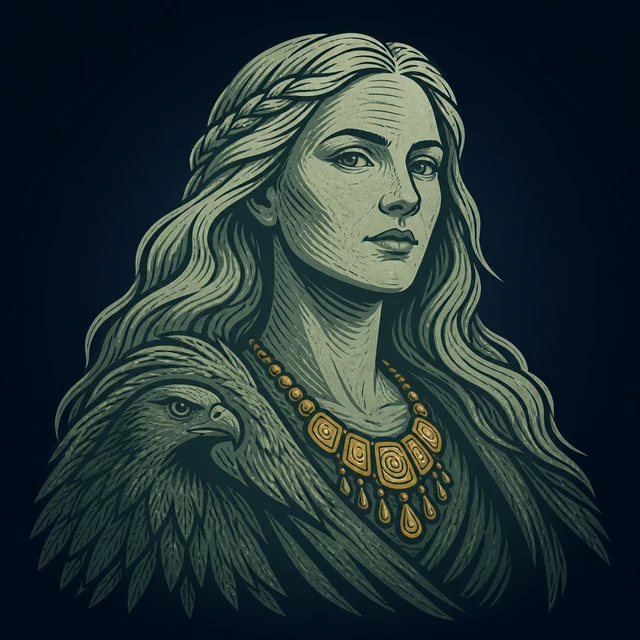
Overview
Freyja is Njord’s daughter and Freyr’s sister in chapter 24, ruling Folkvangr, where half the slain go to her and half to Odin. Chapter 35 also links her to Brisingamen and the Vanir title. This story presents her not as a mere appendage to Odin’s order, but as evidence that Vanir identity enters the divine centre.
Key facts
Shares the slain
Chapter 24 says Freyja keeps half the slain each day, while Odin has the other half.
Holder of Brisingamen
Chapter 35 lists Brisingamen among Freyja’s possessions.
Relationships
- Njordfather of
Chapter 24 says Njord has Freyja.
- Freyrsibling of
Chapter 24 lists Freyr and Freyja as Njord’s two children.
- Brisingamenholds
Chapter 35 lists Brisingamen as Freyja’s possession.
- Thrymdemands as wife
Thrym demands Freyja as wife before returning Mjolnir.
- Giant Master Builderdemands Freyja
The builder demands Freyja as payment for the citadel.
- Hrungnirthreatens to take
Drunken Hrungnir threatens to take Freyja away.
- Lokirebukes
Freyja calls Loki’s speech false and says the gods are angry.
- Njorddefends
Njord intervenes on Freyja’s behalf against Loki’s attack.
- Hyndlawakes and asks to ride
Freyja wakes Hyndla in her cave and asks her to ride.
- Hildisvinirides the gold-bristled boar
Freyja names her mount Hildisvini.
- Hyndlaaccuses of hiding Ottar
Hyndla says Freyja’s companion is Ottar; it is her accusation.
- Hyndlaasks for a lineage recital
Freyja asks Hyndla to name old names and Ottar’s descent.
- Lokiborrows the feather-dress
borrows the feather-dress
- Thrymrefuses to be his wife
refuses to be his wife
Story appearances
- Aesir, Vanir and Divine OrderVanir goddess and slain-share
Freyja brings Vanir identity, love, the slain-share and Brisingamen into the divine centre.
- Thor and the Giant-World TestsDemanded figure
Freyja rejects Thrym’s demand, forcing the gods to find another way to recover the hammer.
- Oaths, Treasures and Giant AftershocksDemanded goddess
When Idunn is taken and when the builder names his price, Freyja's name is pulled into the gods' crisis.
- Lokasenna: Ægir’s FeastFeast figure in Lokasenna
Njord’s daughter, linked to the slain-share, love, tear-gold and Brisingamen.
- Hyndluljoth: Ottar’s Ancestry WagerFigure, mount, or wager in Hyndluljoth
Njord’s daughter, linked to the slain-share, love, tear-gold and Brisingamen.
- Thrymskvitha: Lost Hammer, False Bride, ReversalFigure or artifact in Thrymskvitha
Njord’s daughter, linked to the slain-share, love, tear-gold and Brisingamen.
Ancient sources
MythWeave distinguishes ancient-source evidence from later adaptations and modern interpretation.