Scylla
Many-headed sea monster haunting one side of a narrow strait.
Overview
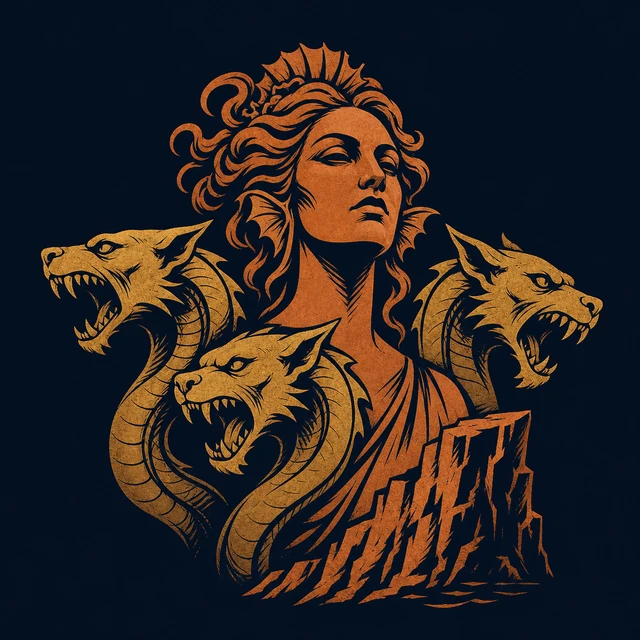
Scylla inhabits a cave high in the strait's cliff and extends six long necks, each head taking one person. Circe advises Odysseus to pass near her rather than risk the whole ship in Charybdis and explicitly tells him not to stop and fight, since he cannot prevent another attack. Odysseus withholds the full warning from his crew so they will not abandon their oars in panic. He arms himself, yet can only watch as six companions are seized. The episode joins the tactical idea of a smaller loss to the ethical question of who bears that cost, offering no clean victory.
Key facts
One man for each head
Odyssey Book 12Scylla takes six crewmen from the ship; vessel and survivors pass through the strait, but the cost is shown as individual human loss.
Circe advises against fighting
Delay would let Scylla strike with all six heads again; the navigational strategy is rapid passage, not heroic combat.
Threat on the return strait
After Circe, Argo passes the dangerous waters of Scylla, Charybdis and the Wandering Rocks.
Relationships
- Odysseusattacks crew
Scylla snatches six companions from the passing ship.
- Argonaut Expeditionthreatens the return
Scylla’s strait is one of the hazards crossed after Circe.
Story appearances
- The Odyssey HomecomingSea monster who takes six crewmen
Avoiding Charybdis brings the ship within Scylla's reach, at the cost of six men.
- The ArgonautsScylla in the Argonaut expedition
Scylla enters this story through the Argonaut expedition; other versions are handled where their own episodes call for them.
Ancient sources
MythWeave distinguishes ancient-source evidence from later adaptations and modern interpretation.
- Homer, Odyssey, Books 1–24
- Apollonius Rhodius, Argonautica, Book 4.294–551: Apsyrtus pursues, is lured and killed
- Apollonius Rhodius, Argonautica, Book 4.552–981: Zeus’ storm, Circe’s purification, Sirens and strait hazards
- Apollonius Rhodius, Argonautica, Book 4.982–1169: Colchian reclamation and the marriage decision
- Apollonius Rhodius, Argonautica, Book 4.1170–1637: Syrtes, carrying Argo and Triton’s guidance
- Apollonius Rhodius, Argonautica, Book 4.1638–1781: Talos, Anaphe and return to Pagasae
- Homer, Odyssey, Book 12: Sirens, sea monsters and the cattle of Helios