Menelaus
King of Sparta, husband of Helen and a leader of the Greek host at Troy.
Overview
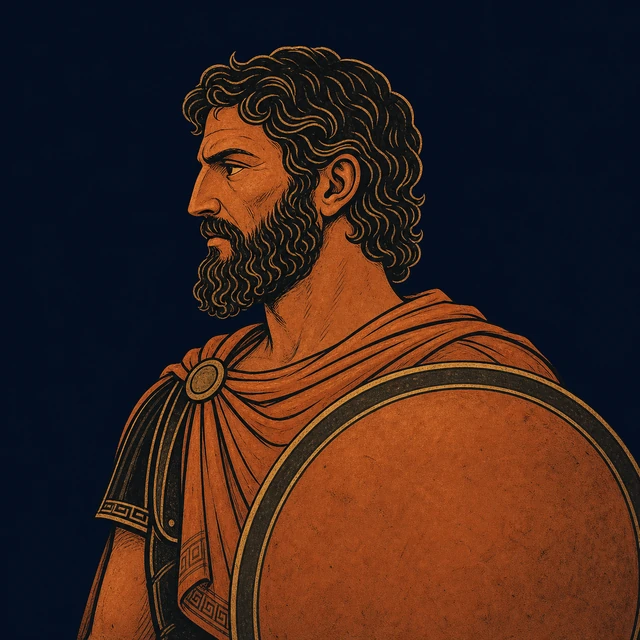
Menelaus is king of Sparta, brother of Agamemnon and husband of Helen. The public purpose of the Trojan expedition is the recovery of his marriage and property. Iliad Book 3 stages a duel in which Paris and Menelaus could settle the war by individual combat. Menelaus gains the advantage, but Aphrodite removes Paris, showing that a mortal victory cannot dissolve a conflict sustained by gods and broken agreements. In Odyssey Book 4 Menelaus has returned to a wealthy court and receives Telemachus with Helen. His account of years of wandering, the capture of the sea god Proteus and news that Odysseus remains detained makes him a major witness connecting Troy to several homecomings.
Key facts
The duel that might have ended the war
Both armies agree that Menelaus and Paris will determine possession of Helen and the treasure; when Menelaus drags his opponent toward defeat, Aphrodite removes Paris from the field.
Learning the returns from Proteus
In Egypt Menelaus restrains the shape-changing Proteus and learns the rites required for return, Agamemnon's fate and that Odysseus remains on Calypso's island.
Relationships
- Agamemnonbrothers
Agamemnon and Menelaus are the brothers of the house of Atreus.
- Helenmarried to
After Helen leaves Sparta, Menelaus rallies the expedition to Troy.
- Trojan Warcampaigns in
Menelaus fights to recover Helen.
- Agamemnonasks to mobilise
Menelaus asks his brother Agamemnon to summon the kings against Troy.
- Parisduels
Paris and Menelaus fight a single combat intended to settle the war.
- Helentakes back to the ships
Pseudo-Apollodorus says Menelaus leads Helen back to the ships.
- Proteusseizes for prophecy
In Odyssey 4, Menelaus seizes Proteus to learn the truth about his return.
Story appearances
- The Trojan WarKing seeking restoration of his marriage
Mobilises his brother, duels Paris and takes Helen back to the ships after the sack.
Ancient sources
MythWeave distinguishes ancient-source evidence from later adaptations and modern interpretation.