Hundred-Handers
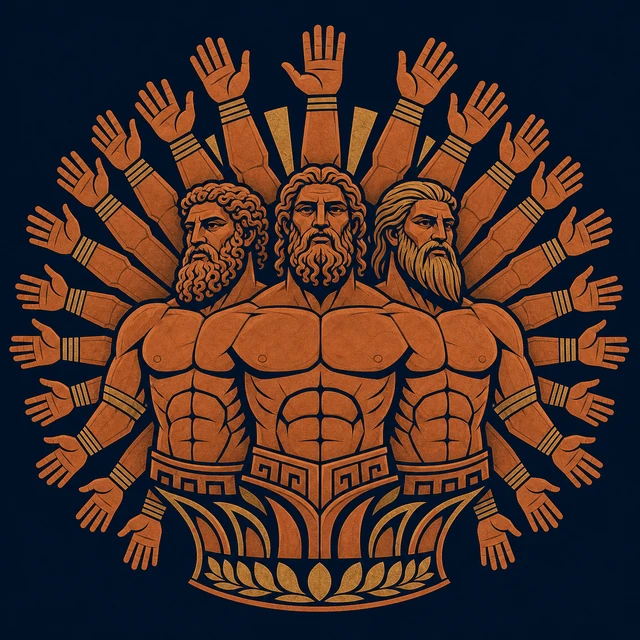
Three brothers with a hundred arms and fifty heads, hidden deep in Earth by Uranus.
Overview
The Hundred-Handers are represented collectively as the brothers Cottus, Briareus and Gyges. They are children of Gaia and Uranus, each with a hundred arms springing from the shoulders and fifty heads. Uranus hates them from the beginning and hides them deep within Earth, making Gaia bear the pressure. The later Theogony narrates their release and battlefield role in the Titanomachy, but that material lies beyond the line 1–506 boundary and is reserved for the next book. They are first imprisoned in the depths, then brought back by Zeus as allies; in the final clash they hurl stones and after the war they guard the defeated Titans.
Key facts
A hundred arms and fifty heads
Hesiod names the three brothers and gives each a hundred unapproachable arms and fifty heads upon the shoulders.
Hidden deep within Earth
Uranus hates and hides the Hundred-Handers, burdening Gaia and prompting her plan of resistance.
Further spoiler details are available in the interactive atlas.
Relationships
- Gaiamother of
Gaia is the mother of the Hundred-Handers.
- Uranusfather of
Uranus is the father of the Hundred-Handers.
- Zeusfrees from bonds
Zeus brings the Hundred-Handers back into the light and frees their bonds.
- Zeusjoin his side
The Hundred-Handers join Zeus's side after release and covenant.
- Campeguards as jailer
Pseudo-Apollodorus makes Campe jailer of the imprisoned Hundred-Handers.
- Titanomachyjoin the decisive battle
The Hundred-Handers join the front rank of the decisive battle after release.
- Titansoverwhelm with three hundred stones
The Hundred-Handers launch three hundred rocks, one upon another, from their strong hands and overwhelm the Titan host.
- Titansbind after defeat
After defeating the Titans, the Hundred-Handers bind them in grievous chains.
- Titansbecome guards over
The Hundred-Handers become guards over the imprisoned Titans.
Story appearances
- Birth of the GodsHidden Hundred-Handed brothers
Three giant sons of Gaia and Uranus hidden deep within Earth; in the Titan war they return as a decisive force.
- The TitanomachyPrisoners becoming decisive force and guards
Prisoners becoming decisive force and guards within the struggle between the older Titans and Zeus' side.
Ancient sources
MythWeave distinguishes ancient-source evidence from later adaptations and modern interpretation.
- Hesiod, Theogony, Lines 126–153: Gaia brings forth Sky, Mountains and Sea, then the children of Gaia and Uranus
- Hesiod, Theogony, Lines 154–187: Uranus hides his children, Gaia plans resistance, Cronus attacks and blood-born consequences follow
- Pseudo-Apollodorus, Bibliotheca, 1.2.1: Metis' drug, ten-year war, Gaia's prophecy, Campe, three weapons, Titan imprisonment and division by lot
- Hesiod, Theogony, Lines 617–653: prolonged war, the Olympus and Othrys camps, Gaia's counsel to free the Hundred-Handers, and Zeus's invitation to fight
- Hesiod, Theogony, Lines 644–663: Zeus invites the Hundred-Handers to fight and Cottus answers, recalling their release
- Pseudo-Apollodorus, Bibliotheca, 1.2.3–5: Menoetius struck during the war with the Titans and Styx with her children fighting for Zeus
- Hesiod, Theogony, Lines 664–686: the Hundred-Handers enter the front rank and the two hosts begin the decisive clash
- Hesiod, Theogony, Lines 687–735: Zeus' thunder, cosmic upheaval, three hundred stones, and the Titans defeated and bound
- Hesiod, Theogony, Lines 507–520: Iapetus' children, Menoetius struck by thunderbolt and Atlas bearing heaven
- Hesiod, Theogony, Lines 736–806: Tartarus' depth, bronze enclosure, gates and threshold
- Hesiod, Theogony, Lines 807–819: the Titans dwelling beyond the gates and the later stations of Cottus, Gyes and Briareus