Rig
The deity in Rigsthula who visits three households under the name Rig.
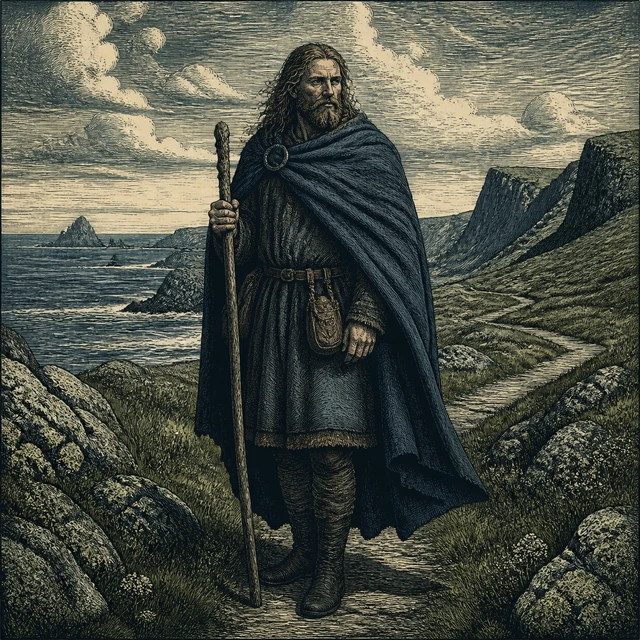
Overview
The opening prose calls the traveller Heimdall, but the poem itself lets him call himself only Rig. Bellows’s introduction also treats that identification as uncertain and notes an Odin reading. This record therefore keeps him as Rig of Rigsthula: he enters three households, later teaches Jarl runes, and shares runes with Young Kon near the fragment’s end, without permanently merging him with a god in other works.
Key facts
Appears only as Rig in the poem
The opening prose’s Heimdall identification is retained beside the poem’s self-name, not converted into fixed identity.
Visits three households
Stanzas 1–35 repeatedly place Rig in three households, forming the poem’s three-part origin account.
Relationships
- Aienters the household
Rig enters the first household of Ai and Edda.
- Eddashares table and bed
Rig shares a table and spends three nights in bed with Edda and Ai.
- Thrallpoem-bound fathering
Nine months after Rig leaves, Edda bears Thrall.
- Karlpoem-bound fathering
Nine months after Rig leaves the second household, Amma bears Karl.
- Jarlpoem-bound fathering
Nine months after Rig leaves the third household, Mothir bears Jarl.
- Jarlteaches runes
Rig teaches Jarl runes, calls him son, and tells him to hold a wide inheritance.
- Young Konshares runes
Kon shares runes with Rig-Jarl but receives no completed royal ending.
Story appearances
- Rigsthula: Three Households and Young KonFigure in Rig’s three households and the Young Kon fragment
The deity in Rigsthula who visits three households under the name Rig.
Ancient sources
MythWeave distinguishes ancient-source evidence from later adaptations and modern interpretation.